How to Build a Senior Living Marketing Plan That Fills Occupancy

A marketing plan for a senior living community that actually works connects every channel, tactic, and budget line back to one number: occupancy rate. Most plans fail not because of bad ideas, but because they list activities without tying them to goals, attribution, or accountability.

While many operators create plans internally, partnering with a specialized senior living marketing agency often provides the expertise and execution needed to turn a plan into measurable occupancy growth.

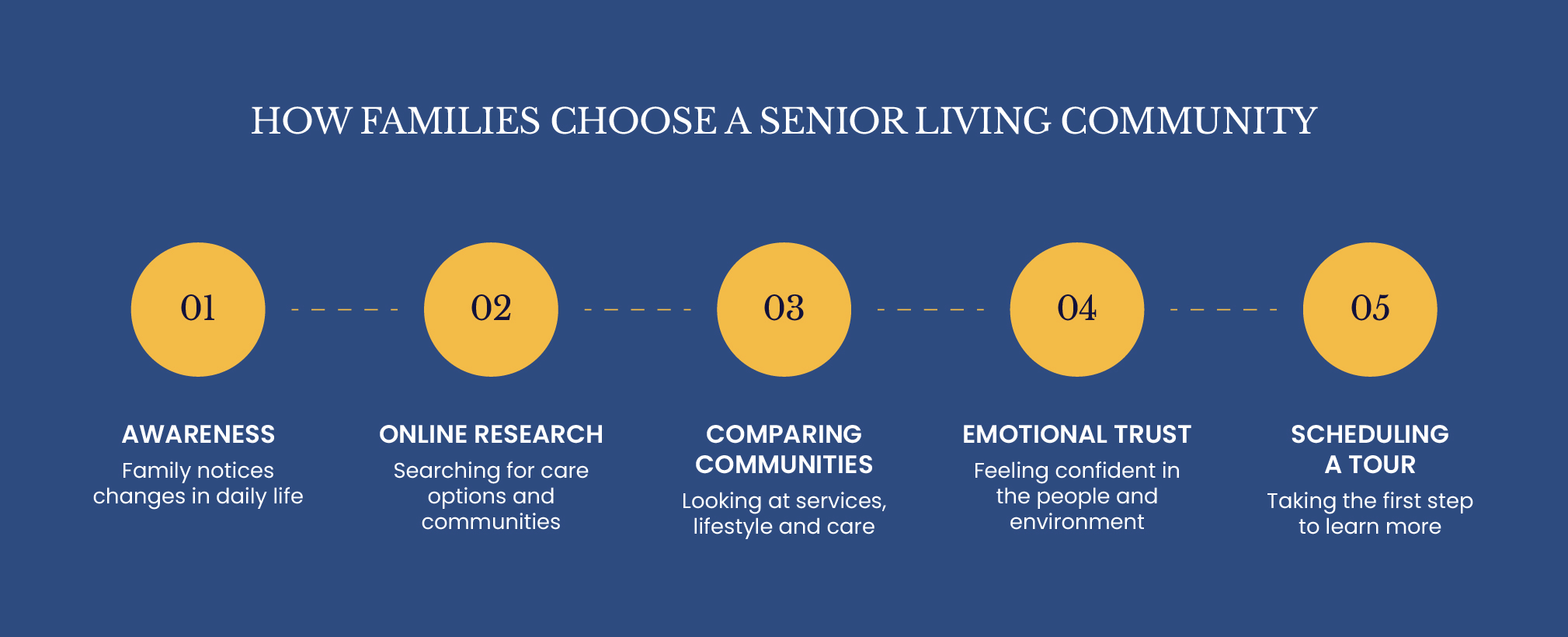
Families are researching care options online long before they schedule a tour. They compare communities, read reviews, visit websites, and evaluate trust signals before contacting anyone.

Setting Occupancy Goals and Working Backward to Marketing Indicators

Every marketing plan for senior living community growth should begin with a simple question: what occupancy rate are you trying to achieve, and by when?

Your marketing plan must determine how many move-ins are required to close the gap that you have. From there, you can work backward through the sales funnel to calculate the number of tours, inquiries, and website conversions needed to reach that target.

Core Metrics Every Senior Living Community Should Track

  • Cost per qualified inquiry
  • Inquiry-to-tour conversion rate
  • Tour-to-move-in conversion rate
  • Website conversion rate
  • Site admin rate
  • Occupancy growth trend

According to the National Investment Center for Seniors Housing & Care, occupancy remains one of the most important performance indicators in senior housing operations. Tracking inquiries without connecting them to move-ins makes it impossible to determine which marketing investments are actually generating results.

Most communities track website traffic and social media engagement. High-performing communities track admissions, occupancy growth, and return on investment.

marketing-plan-for-senior-living-community

Build a Channel Strategy Around How Families Search for Care

The most effective marketing plan for senior living community growth aligns marketing channels with how families actually research care options.

Families searching for assisted living, independent living, or memory care often begin with Google. They compare providers, read reviews, evaluate websites, and search for specific care services within their local market.

Local SEO Creates Sustainable Occupancy Growth

Local SEO should be the foundation of every senior living marketing plan.

High-intent searches such as:

  • Assisted living near me
  • Memory care near me
  • Senior living communities in Denver
  • Assisted living communities in my area

represent families actively searching for care solutions.

A fully optimized Google Business Profile, location-focused content, and strong local search visibility help communities capture demand at the exact moment families are looking

Golden Chapter’s approach to senior living SEO focuses on increasing visibility across Google Search, Google Maps, and AI-powered search platforms.

PPC Captures Immediate Demand

While SEO builds long-term visibility, PPC generates immediate opportunities.

A well-structured PPC campaign targets high-intent keywords, geographic service areas, and conversion-focused landing pages designed specifically for senior living operators.

Unlike generic healthcare advertising, senior living PPC should be measured by qualified inquiries, tours, and move-ins rather than clicks alone.

Reputation Management Influences Family Decisions

Families frequently compare online reviews before contacting a community.

Research from the Centers for Medicare & Medicaid Services (CMS) shows that publicly available quality information influences healthcare decision-making.

Families commonly evaluate:

  • Google Reviews
  • Community testimonials
  • Senior living directories
  • Quality indicators
  • Online reputation signals

Communities with strong reviews, active responses, and consistent reputation management often generate more inquiries than competitors with weaker online trust signals.

marketing plan f0r senior living community

Create Content and Messaging That Builds Family Trust

Families researching senior living are not looking for marketing language. They are looking for confidence.

They want evidence that your community is safe, professional, responsive, and capable of meeting their loved one’s needs.

Content that answers those concerns consistently outperforms generic lifestyle messaging.

The Information Families Actually Want

Families commonly search for information about:

  • Daily life within the community
  • Care services and specialties
  • Staff qualifications
  • Safety procedures
  • Resident experiences
  • Family testimonials
  • Costs and expectations

According to LeadingAge, trust and transparency remain critical factors when families evaluate senior living providers.

Why Website Design Impacts Occupancy

Your website is often the first interaction families have with your community.

If the site is difficult to navigate, loads slowly, or lacks trust-building information, prospective residents may never contact your team.

Golden Chapter specializes in senior living website design that prioritizes accessibility, intuitive navigation, and conversion-focused user experiences for seniors and their families.

Reporting, Attribution, and Knowing What Is Working

A plan without reporting is a wish list. The reporting layer of your marketing plan for senior living community should answer one question every month: which channels produced qualified inquiries, what did they cost, and how many converted to move-ins?

Most agencies report on activity. A specialized senior living marketing agency reports on outcomes. 

Building In-House vs Hiring a Senior Living Marketing Agency

Many operators eventually face the same question: should marketing be managed internally or through a specialized senior living marketing agency?

The answer depends on available expertise, staffing resources, and growth goals.

Communities evaluating external support should review how different senior living marketing agencies approach occupancy growth, attribution, and reporting.

marketing-plan-f0r-senior-living-community

Ready to Turn Your Marketing Plan Into a System That Drives Move-Ins?

A documented plan is only the first step. Occupancy growth happens when strategy, execution, reporting, and optimization work together as a single system.

Golden Chapter combines more than 20 years of digital marketing experience with specialized expertise in senior living marketing, assisted living marketing, SEO, PPC, branding, website design, email marketing, and social media management.

We help senior living communities improve visibility, build trust, generate qualified inquiries, and increase move-ins through measurable, data-driven marketing.

Frequently Asked Questions

What Should a Marketing Plan for Senior Living Community Growth Include?

A marketing plan for senior living community growth should include occupancy goals, marketing KPIs, channel strategies, content planning, budget allocation, conversion benchmarks, and reporting systems that connect inquiries and tours to move-ins. The most effective plans focus on measurable outcomes rather than marketing activity alone.

What Does a Senior Living Marketing Agency Do?

A senior living marketing agency helps communities increase visibility, generate qualified inquiries, improve occupancy, and strengthen trust with prospective residents and families. Services often include SEO, PPC, website design, branding, social media management, content marketing, and performance reporting.

How Do Senior Living Communities Increase Occupancy?

Senior living communities increase occupancy by improving local search visibility, generating qualified inquiries, strengthening online reputation, optimizing website conversions, creating trust-focused content, and improving the conversion process from inquiry through move-in.

Is SEO Important for Senior Living Communities?

Yes. SEO helps senior living communities appear when families actively search for care options online. Strong SEO improves visibility in Google Search, Google Maps, AI-powered search engines, and local search results, generating sustainable inquiry growth over time.

How to Market an Assisted Living Facility: What Actually Works

Marketing an assisted living facility successfully requires more than advertising. If you’re wondering how to market an assisted living facility, the answer is a combination of strong positioning, a conversion-focused website, local SEO, referral partnerships, reputation management, and strategic paid advertising.

Communities that consistently maintain occupancy treat marketing as a system designed to generate tours and move-ins. Many achieve better results by partnering with a specialized senior living marketing agency that understands senior care, family decision-making, and occupancy growth.

Families searching for assisted living communities are often making emotional and time-sensitive decisions. According to the National Institute on Aging, families evaluate quality of care, safety, staffing, services, and reputation before choosing a community.

Positioning and Messaging Come Before Marketing Channels

Many assisted living communities invest in advertising before they clearly define why families should choose them.

Families are not comparing activity calendars or dining menus. They are comparing trust, care quality, safety, communication, and overall resident experience. If you are wondering how to market an assisted living facility the answer is simple ; your marketing should immediately communicate what makes your community different.

What Families Actually Want to Know

When evaluating options, families typically ask:

  • Why should we choose your community instead of another nearby option?
  • What level of care and support do residents receive?
  • How does your staff communicate with families?
  • What evidence shows residents receive quality care?

Communities that answer these questions consistently across their website, advertising, and sales process typically generate more qualified inquiries and tours.

how-to-market-an-assisted-living-facility

Your Website Should Function as a Conversion Tool

Many assisted living websites operate like digital brochures. They provide information but fail to convert visitors into prospects.

A high-performing website should guide families toward scheduling a tour, requesting information, or speaking with a community representative.

Essential Website Elements

The primary goal of every page is to move a family from “we’re considering options” to “we called and scheduled a tour.” 

According to the U.S. Department of Health and Human Services, transparency and accessible information help consumers make informed healthcare decisions.

Every assisted living website should include:

  • Clear calls to action for tours and consultations
  • Resident and family testimonials
  • Care level descriptions
  • Staff and leadership information
  • Frequently asked questions
  • Easy-to-find contact information

Communities looking to improve lead generation often benefit from specialized senior living marketing services that focus on conversion optimization rather than simply increasing website traffic.

Mobile Experience Matters

Most families begin researching assisted living options on mobile devices. Slow load times, confusing navigation, or difficult contact forms can significantly reduce inquiries and tour requests.

Local SEO and Google Business Profile Drive High-Intent Leads

For many communities, local search visibility produces the highest return on investment.

When families search for assisted living options, Google often displays local map results before traditional website listings. Appearing in those results can significantly increase calls, website visits, and tour requests.

Google Business Profile Optimization

An optimized Google Business Profile should include:

  • Accurate contact information
  • Updated business hours
  • Professional photography
  • Service descriptions
  • Regular updates and posts
  • Active review management

Google identifies relevance, distance, and prominence as important local ranking factors through its Google Business Profile guidelines.

Communities that combine Google Business Profile optimization with a dedicated SEO for senior living strategy often build a stronger long-term occupancy pipeline than those relying solely on advertising.

Referral Networks Continue to Generate Qualified Prospects

Digital marketing is critical, but referral relationships remain one of the most valuable lead sources in senior living.

According to the National Center for Assisted Living, healthcare professionals often influence long-term care decisions.

Key Referral Sources

Strong referral networks typically include:

  • Hospital discharge planners
  • Geriatric care managers
  • Home health agencies
  • Rehabilitation facilities
  • Elder law attorneys
  • Physicians and specialists

Communities that consistently invest in these relationships often experience higher-quality leads and shorter sales cycles because prospects arrive with an established level of trust.

Paid Search Helps Fill Occupancy Gaps Faster

SEO and referral marketing build long-term demand, but paid advertising can generate immediate visibility.

Families frequently search for assisted living options during moments of urgency. A targeted PPC for senior living campaign can position your community in front of families actively searching for care.
Comparing Assisted Living Marketing Channels

The most successful communities typically combine multiple channels rather than relying on a single source of leads.

how t0 market an assisted living facility

Reputation Management Influences Every Stage of the Decision Process

Reviews have become one of the strongest trust signals in senior living marketing.

Families often read multiple reviews before scheduling a tour. Positive reviews reinforce trust, while thoughtful responses to negative reviews demonstrate transparency and professionalism.

A proactive review strategy should include requesting feedback from satisfied families, monitoring review platforms regularly, and responding professionally to all feedback.

Communities seeking additional ideas can explore these proven senior living marketing ideas to strengthen visibility and reputation.

Marketing Channel Comparison: What Each Channel Does and What to Measure

The table below outlines the five core channels for marketing an assisted living facility.

ChannelWhat It Does for YouPerformance Signal to Track
Google Business ProfileCaptures local search intent and drives calls, direction requests, and website visits from nearby familiesProfile views, direction requests, and call clicks per month
Local SEOPositions your facility for organic searches like “assisted living near me” and city-specific queriesKeyword ranking movement and organic traffic to service pages
Paid Search (PPC)Captures urgent demand from families who need placement now, highest-intent traffic sourceCost per lead and lead-to-tour conversion rate
Referral NetworkConnects your facility to hospital discharge planners and social workers who place residents activelyNumber of referral partners and referral-sourced move-ins per quarter
Reputation / ReviewsBuilds trust before the first phone call, families check Google reviews before contacting any facilityStar rating, review volume, and response rate
how-to-market-an-assisted-living-home

Frequently Asked Questions

How Do You Market an Assisted Living Facility Effectively?

The most effective approach to how to market an assisted living facility combines local SEO, Google Business Profile optimization, referral partnerships, online reputation management, and targeted advertising. Successful communities focus on generating trust and visibility while creating clear pathways for families to schedule tours and request information.

What is the Most Effective Marketing Channel for Assisted Living Communities?

There is no single best channel. Most communities generate the strongest results by combining local SEO, referral marketing, review management, and paid search campaigns. Each channel supports a different stage of the family decision-making process and contributes to overall occupancy growth.

Why is Local SEO Important for Assisted Living Facilities?

Local SEO improves visibility when families search for terms such as “assisted living near me” or “assisted living in Denver.” Strong local rankings help communities attract high-intent prospects who are actively researching care options and comparing providers.

How Important Are Online Reviews for Assisted Living Marketing?

Online reviews are one of the strongest trust signals available. Reviews influence both local search visibility and consumer confidence. Communities that consistently generate positive reviews and respond professionally to feedback often experience higher inquiry and tour conversion rates.

Ready to Improve Occupancy and Generate More Qualified Tours?

The communities that consistently maintain high occupancy rates rarely rely on a single marketing tactic. They build systems that combine local SEO, referral development, reputation management, paid search, and conversion-focused websites.

If your current marketing efforts are not producing consistent move-ins, Golden Chapter can help identify the gaps. 

Senior Living Digital Marketing: What Works, What Wastes Budget, and What to Demand From Your Agency

Senior living digital marketing covers every online channel used to attract families, generate qualified inquiries, and drive move-ins: local SEO, Google Business Profile, paid search, social media, website conversion, email, and AI search visibility. Not all of those channels produce equal results. 

A senior living marketing agency should show which channels are generating genuine interest from families and which are only creating activity. Golden Chapter Marketing focuses on making that picture easier to understand, with data-driven marketing built for assisted living, senior care, and senior living centers.

senior-living-digital-marketing

Senior Living Digital Marketing Starts With Local Search

For most communities, local SEO and Google Business Profile should be the foundation of senior living digital marketing. Families often search by location, care type, and urgency when they are comparing options for a parent or loved one.

Searches like “assisted living near me,” “memory care in [city],” or “senior living community near me” are not casual searches. They usually come from families who are already trying to understand options, compare trust signals, and decide which communities deserve a call or tour. 

The National Institute on Aging explains that families should compare services, care needs, location, costs, and quality when choosing long-term care. That means your website, Google Business Profile, service pages, and reviews need to support the same decision process.

A strong SEO for senior living strategy should focus on location pages, service-specific content, review signals, technical SEO, and clear calls to action.

What good performance looks like:

  • Google Business Profile is complete, accurate, and actively maintained
  • Local pages target real care types and service areas
  • Reviews are monitored and answered consistently
  • Organic traffic is connected to calls, form fills, and tour interest
  • Reporting shows inquiry volume from organic search and GBP

Paid Search Should Capture Demand, Not Just Clicks

Paid search is the right channel for capturing families who are actively searching and ready to inquire. 

PPC works best when it supports a clear goal. A senior living marketing agency should be able to show:

  • Which campaigns are helping fill open beds
  • Which campaigns are promoting a specific care level
  • Which campaigns are increasing tour requests
  • Which search terms are wasting spend
  • Which landing pages need improvement
  • Which paid leads are turning into qualified calls or inquiries

Social Media And Email Support The Decision Cycle

Social media and email matter, but they should be understood correctly. For most communities, support and nurture trust rather than drive the first inquiry at scale.

Social media 

Social media helps families see community life, resident engagement, events, staff culture, and the emotional tone of the brand. It should not be judged only by likes or reach. A senior living community should look at profile visits, link clicks, comments, message quality, and how social content reinforces the trust families need before contacting the community.

Email marketing 

Email has two different jobs in senior living. Family communication keeps current resident families informed with updates, events, and community news. Prospect nurturing helps undecided families stay engaged after they submit a form, download information, or schedule an initial call.

senior-living-digital-marketing (GBP)

AI Search Visibility: The Channel Most Operators Are Missing

AI search is becoming part of how families research senior living options. Tools like Google AI features, ChatGPT, and Perplexity can summarize answers before a family ever clicks a website.

That does not replace SEO, but it changes how content should be structured. Senior living websites need clear answers, strong service pages, specific location information, and content that explains care options in language families understand.

AI search visibility depends on clarity, authority, and structure. The goal is not just to rank. The goal is to make it easier for search engines, AI systems, and families to understand.

The W3C Web Accessibility Initiative explains that accessible digital content helps people with diverse needs use websites more effectively. For senior living, that is especially important because websites may be used by older adults, adult children, and family decision-makers.

What A Senior Living Marketing Agency Should Report

A senior living marketing agency should report on outcomes that connect marketing activity to occupancy goals.

Here is a clearer way to evaluate each channel:

ChannelMain RoleWeak MetricBetter Metric
Local SEO + GBPCapture local family demandRankings aloneCalls, form fills, map actions, qualified inquiries
Paid SearchCapture urgent search demandClicks and impressionsCost per qualified inquiry, call quality, landing page conversion
Social MediaBuild trust and visibilityLikes and reachProfile visits, link clicks, message quality, engagement sentiment
Email To FamiliesSupport retention and communicationOpen rate aloneReplies, event engagement, family feedback
Email To ProspectsNurture undecided familiesSends and opensTour requests, re-engagement, inquiry-to-tour movement
AI SearchImprove emerging discoverabilityMentions aloneAI referral traffic, cited answers, direct-answer visibility
senior living digital marketing (GBP)

Is Your Digital Marketing Driving Move-Ins?

Most senior living communities do not need more disconnected marketing activity. They need a channel mix that helps families find them, trust them, contact them, and schedule a tour.

Golden Chapter Marketing helps assisted living, senior care, and senior living centers improve visibility, build trust, and increase move-ins.

Frequently Asked Questions

What is senior living digital marketing? 

Senior living digital marketing is the use of online channels to help families discover, evaluate, and contact senior living communities. It includes local SEO, Google Business Profile, paid search, social media, email marketing, website design, content, and AI search visibility.

Which digital marketing channel works best for senior living? 

Local SEO and Google Business Profile are often the strongest foundation because they reach families searching by location and care need. Paid search can add faster demand capture. Social media and email usually work best as trust-building and nurturing channels.

What should a senior living marketing agency report on each month? 

A senior living marketing agency should report qualified inquiries, calls, form fills, tour requests, Google Business Profile activity, paid search cost per inquiry, organic visibility, and website conversion data.

Why does AI search matter for senior living communities?

AI search matters because families may receive direct answers from search tools before visiting a website.

How to Choose a Senior Living Marketing Agency That Actually Fills Beds

The right senior living marketing agency understands how families choose care, measures success by qualified inquiries and move-ins, and connects marketing activity to occupancy outcomes. 

The best senior living marketing agencies do not stop at clicks, impressions, or traffic. They build local visibility, strengthen trust, improve website conversion, and report on the numbers that matter to senior living operators.

For communities comparing partners, the real question is simple: can this agency help more families find, trust, tour, and choose your community?

What Separates a Senior Living Specialist From a Generalist Agency

Most digital marketing agencies can run ads, write blog posts, or update a website. What they cannot replicate is an operational understanding of how families choose a senior living community. 

Families often compare safety, services, costs, staff, reputation, and quality of life before they schedule a tour. The National Institute on Aging recommends evaluating care needs, services, location, costs, and quality when choosing long-term care.

That means senior living marketing cannot be built around generic visibility. It needs to support trust at every stage of the family decision cycle.

A specialist agency should understand how to:

  • Build local SEO around high-intent senior care searches
  • Optimize Google Business Profile for calls, directions, and tour interest
  • Create website content that answers family concerns clearly
  • Track qualified inquiries, tours, and move-ins by channel
  • Make digital marketing simple enough for operators to understand

This is where Golden Chapter’s focus matters. As a senior living marketing agency, Golden Chapter Marketing supports assisted living, senior care, and senior living centers with SEO, PPC, branding, website design, email marketing, and social media built around visibility, trust, and move-ins.

senior.living.marketing.agencies

How Senior Living Marketing Agencies Should Prove Results

The clearest difference between a generalist and a specialist is attribution. A generalist agency may show impressions, reach, clicks, and keyword movement. Those numbers have value, but they do not prove that your census is improving.

Strong senior living marketing agencies connect marketing activity to business outcomes. That means reporting should show how each channel contributes to inquiries, tours, and move-ins.

For operators reviewing marketing senior living services, the goal should not be more marketing activity. The goal should be clearer movement from search visibility to family trust to qualified tour interest.

4 Questions to Ask Any Senior Living Marketing Agency Before Signing

Before choosing a partner, ask questions that force the agency to prove senior living expertise.

  • What is your documented site admit rate improvement across clients?            

A real specialist should be able to explain how website visitors become qualified inquiries, tours, or move-ins.

  • Can you show a ranking case study specific to a senior living keyword? 

Generic SEO performance does not always transfer to senior living. Ask for proof tied to assisted living, senior care, memory care, or local senior living searches.

  • How do you attribute move-ins to marketing channels? 

This is the accountability question. The agency should explain how they connect marketing activity to actual admissions data. Clear attribution helps operators understand what is working.

  • What does your Google Business Profile workflow look like for senior living? 

Google says businesses with complete and accurate Business Profile information are more likely to show up for relevant local searches. That makes Google Business Profile optimization a core task in senior living marketing, not an afterthought.

Red Flags vs. Right Signals: How to Read Agency Responses

What They SayRed FlagRight Signal
“We improve your online visibility.”Too vague and not tied to occupancy.They show how rankings, calls, and inquiries changed.
“We track clicks and impressions.”Vanity metrics are the main report.They report qualified inquiries, tours, and move-in attribution.
“We can start with social and email.”Lower-intent channels come before search demand.They prioritize local SEO, GBP, website conversion, and paid search.
“Our reports show monthly reach.”Activity is reported without business context.Reports connect channel performance to occupancy goals.
senior-living-marketing-agencies

What Good Results Actually Look Like

Good senior living marketing is not measured by traffic alone. Search volume for operator-facing senior living terms can be modest, but every qualified visitor matters more when they are actively comparing services or agencies.

A complete strategy should also include SEO for senior living, website conversion improvements, PPC focused on trackable ROI, and brand messaging that builds trust with families.

This also matters for AI search. As families use AI-assisted search tools to compare senior living options, communities need clear, structured, trustworthy content that is understandable to both people and search systems.

Ready to See What a Senior Living Marketing Agency Should Actually Deliver?

If you are actively comparing senior living marketing agencies and want a benchmark grounded in real occupancy data, not projections, the free marketing audit at Golden Chapter Marketing is the starting point.

Frequently Asked Questions

What does a senior living marketing agency do? 

A senior living marketing agency helps assisted living, senior care, and senior living communities get found online, build trust with families, and increase the number of qualified inquiries. Services often include SEO, PPC, Google Business Profile optimization, website design, branding, reputation management, content marketing, email marketing, and social media marketing.

How do I know if my current senior living marketing agency is performing?

Ask for metrics tied to business outcomes, not just activity. Strong reporting should include qualified inquiry volume, inquiry-to-tour rate, cost per qualified inquiry, website conversion rate, Google Business Profile performance, and move-in attribution.

What is the difference between a senior living marketing agency and a general healthcare marketing agency? 

Senior living marketing focuses on families choosing care, comfort, safety, trust, and quality of life. The buyer is often an adult child comparing options for a parent. That makes reputation, local visibility, testimonials, website clarity, and practical service information essential parts of senior care marketing.

What Is Senior Care Marketing and Why Most Communities Get It Wrong

Senior care marketing is the practice of connecting assisted living, memory care, and senior living communities with the families actively searching for them, and converting that attention into tours, move-ins, and sustained occupancy. 

It differs from general digital marketing in ways that matter: the buyer is almost never the future resident, the decision cycle runs 3 to 12 weeks of active research, and the trust signals that convert are specific to care, not commerce. 

senior-care-marketing-ideas

The Client Is Not Who Most Communities Are Marketing To

Most senior living marketing is aimed at the wrong audience. Websites with language like “enjoy your golden years” and imagery of independent seniors playing golf are speaking to the resident, but the person making the placement decision is almost always an adult child, typically between 45 and 65, managing a parent’s declining health while balancing their own work and family obligations.

This person is not searching for leisure. They are searching for answers to specific, urgent questions: is this place safe, will my parents be treated with dignity, what does care actually look like day to day, and can I trust the people running this community?

The AARP Public Policy Institute has documented extensively that family caregivers are the primary decision-makers in senior care transitions, yet most community marketing materials are not written for them.

Effective senior care marketing reorients every message to the family buyer: the website copy, the ad creative, the review response strategy, and the blog content. Communities that make this shift see measurable improvement in tour conversion rates because the right person finally feels addressed.

The Decision Cycle Is Long, and the Research Window Is Specific

A family does not search “assisted living near me” and call the same afternoon. Research from the National Institute on Aging shows that long-term care decisions involve multiple family members, several touchpoints, and a decision timeline that often lasts three to twelve weeks from the first search to the first tour.

That decision window follows a clear pattern:

  • Broad informational searches begin the process, such as “what is the difference between assisted living and memory care” or “how much does senior living cost in [city]”
  • Comparison searches come next, including “best assisted living communities near me” or “reviews for [community name].”
  • High-intent decision searches happen last, like “schedule a tour” or “contact [community name]”

What This Means for Your Marketing

Communities that only invest in bottom-funnel tactics, paid ads targeting people ready to call, miss the families still in the research phase who will eventually convert at higher rates because they have already built trust through content. A senior living SEO strategy that covers all three phases of the search window captures families at every stage, not just the ones already in crisis.

The comparison table below shows how marketing channels map to the decision cycle:

Decision StageWhat Families Are DoingChannel That Reaches Them
AwarenessBroad research, defining optionsBlog content, local SEO, GBP
ConsiderationComparing communities, reading reviewsReputation management, social proof
DecisionReady to tour or callPaid search, direct CTA, GBP calls
senior.care.marketing

The Trust Signals That Actually Convert – And the Ones That Don’t

Senior care is a high-stakes, emotionally charged purchase. The trust signals that move families from research to action are not the ones most communities lead with.

What Works

  • Clinical credentials and staff qualifications referenced specifically, not generically
  • Family testimonials that describe a real experience, not a marketing-polished quote
  • Response behavior on Google reviews, how a community handles criticism publicly says more than any brochure
  • Local SEO visibility that puts the community in the map pack when families search by location

What Doesn’t

Most community websites function as digital brochures: a homepage with amenity photos, a services page with a list, and a contact form at the bottom. There is no content that answers the questions families are actually searching for, no social proof integrated into the conversion path, and no reason for Google to rank the site above competitors with more authoritative content.

The communities that rely on referrals as their primary channel face a different problem: referral volume is unpredictable, unscalable, and invisible to attribution. When a discharge planner retires or a hospital changes its referral protocol, the pipeline disappears overnight. Senior care marketing built on a single channel is not a strategy; it is a dependency.

The Most Common Mistakes Communities Make

Most senior care marketing failures come down to four patterns:

  • Treating the website as a brochure rather than a conversion tool with a defined user journey
  • Ignoring Google Business Profile until a negative review surfaces, then reacting instead of managing
  • Hiring a generalist agency that applies e-commerce or retail logic to a relationship-driven, compliance-sensitive industry
  • Overlooking emerging channels, particularly AI search visibility, where communities that are not optimized for tools like ChatGPT and Perplexity are already invisible to a growing segment of family researchers

That last point is worth expanding. AI SEO for senior living is not a future consideration; it is a present gap. Families are increasingly using AI tools to answer early-stage research questions, and communities without structured, citation-worthy content are not appearing in those answers. Golden Chapter builds AI search visibility into every content engagement because the communities that establish authority in AI results now will hold a compounding advantage over those that wait.

Senior Care Marketing Ideas

Is Your Senior Care Marketing Built for the Buyer Who Actually Decides?

Most communities discover the gap in their marketing when occupancy targets are missed, and no single tactic can explain why. The answer is rarely one broken channel; it is a strategy that was never built around the right buyer, the right decision cycle, or the right trust signals.

Golden Chapter Marketing works exclusively with assisted living, memory care, and senior living communities. Request a free audit to find out whether your current marketing is built to convert the families searching for you right now.

Frequently Asked Questions

What is senior care marketing?

Senior care marketing is the practice of connecting assisted living, memory care, and senior living communities with families searching for placement options and converting that attention into tours and move-ins. 

Why is senior care marketing different from regular healthcare marketing?

Senior care marketing targets a family decision-maker rather than a patient, involves a longer research cycle than most healthcare decisions, and requires trust-building across multiple channels before a family will tour. The regulatory environment, the emotional weight of the decision, and the local nature of the search all require a specialized approach. 

What do families look for when choosing a senior living community?

Families evaluating senior living communities prioritize safety, staff quality, and social environment above amenities or price. Online reviews, response behavior to negative feedback, and visible staff credentials carry significant weight in the decision. 

How long does it take for senior care marketing to produce results?

Timeline depends on the channel. Paid search produces leads within days of launch but requires ongoing spend to maintain volume. Local SEO and Google Business Profile optimization typically produce measurable ranking improvements within 60 to 90 days, with compounding returns over six to twelve months. Content marketing builds topical authority over time and becomes the highest-ROI channel at scale. 

Marketing Ideas for Retirement Communities

The marketing ideas for retirement communities that consistently produce move-ins in 2026 range from community events and open house days to local SEO, paid search, and referral network development, but knowing which channels and tactics produce occupancy at each stage of growth is what separates communities with waiting lists from those chasing targets.

The difference is rarely the tactics themselves; it is whether they run as a coordinated system with a strategy behind them. Every effective senior living marketing agency built exclusively for this industry understands that distinction.

Local SEO and Google Business Profile

For most assisted living and senior living communities, Google Business Profile (GBP) is the highest-return organic channel. When an adult child searches “assisted living near me” or “memory care in [city],” your GBP listing is what appears in the local map pack, above organic results and, often, above paid ads for non-branded queries.

What GBP Optimization Actually Requires

A complete, accurate, and actively managed GBP listing is not optional; it is the foundation. The National Institute on Aging notes that more than 70 percent of people turning 65 today will need some form of long-term care, and the families making those placement decisions begin their search online. If your GBP listing is incomplete, has unanswered reviews, or lacks current photos and service descriptions, you are invisible to the audience actively searching for you right now.

The non-negotiables: primary category set to “Assisted Living Facility” or “Retirement Community” as appropriate, service areas defined to your actual target radius, NAP (name, address, phone) matching your website exactly, and a post tied to each new content piece on your site. 

Local SEO Beyond the Map Pack

Ranking organically for city-specific and neighborhood-specific search queries requires consistent on-page optimization, location-relevant content, and a clean internal linking structure.

A dedicated senior living SEO strategy addresses all of these, but at a minimum, every community should have a city-specific service page, a location-relevant content cadence, and schema markup (LocalBusiness and Organization) correctly implemented.

Golden Chapter’s local SEO for senior living framework is built specifically around the queries families type during the research window, not generic SEO checklists.

marketing ideas for retirement

Paid Search: Families Who Are Ready to Decide Now

Paid search (Google Ads) operates differently from SEO; it captures demand that already exists rather than building it over time.

The campaigns that produce qualified leads for senior living communities target high-intent keywords, use ad copy that addresses family trust concerns rather than price, and send traffic to landing pages designed for a single action: booking a tour. Generic PPC campaigns that send traffic to a homepage produce impressions and spend, not admissions.

FactorPaid Search (PPC)Local SEO / GBP
Timeline to resultsImmediate (days)3-6 months
Cost structurePay per click – ongoing spendTime/agency investment – compounds
Best forUrgent demand, specific campaignsLong-term visibility, brand authority
Lead qualityHigh intent, shorter decision windowHigh trust, longer research cycle
Stops working whenBudget is pausedSite or GBP is neglected

The mistake most communities make is running PPC for senior living without proper attribution, spending on clicks without knowing which campaigns produce tours and move-ins.

Referral Network Development

Referral relationships with healthcare providers, hospital discharge planners, primary care physicians, rehabilitation facilities, and social workers remain among the highest-converting lead sources in senior living. The families these professionals refer to are often in decision mode within days, not weeks.

Three things make it work:

  • A defined outreach cadence to local healthcare providers with clear collateral about your care model
  • A follow-up protocol after every referral: a thank-you, a family update, a reason to stay in contact
  • A simple CRM to track which sources produce move-ins vs tours that go nowhere

Communities that systematize this consistently outperform those that rely solely on word-of-mouth.

Community Events: Marketing Tactics

One of the most underused marketing ideas for retirement communities is the open house, not as a passive tour, but as a structured experience designed to remove the fear families associate with the decision. Activity days, themed events, and seasonal gatherings give prospective residents and their families a reason to walk through the door before they are in crisis mode.

Here are event ideas that work well throughout the year:

  • Valentine’s Day Brunch: invite families and prospective residents for a sit-down brunch with live music or a pianist. Low pressure, high warmth.
  • St. Patrick’s Day Social: a themed afternoon with Irish-inspired food, trivia, and a tour woven in naturally at the end
  • Spring Open House: garden walkthrough, resident art display, and light refreshments. Let the community speak for itself.
  • Mother’s Day Tea: one of the highest-attendance events in senior living. Families come; some stay to ask questions.
  • Around the World Dinner Night: each month highlights a different culture through food, music, and activities. Creates a recurring reason to visit.
  • Summer Family BBQ: casual format lowers guard for families who are still evaluating. Staff visibility matters here.
  • Fall Harvest Festival: seasonal activities, pumpkin decorating, and a community tour framed as part of the experience
  • Holiday Cookie Exchange: December event that keeps your community top of mind during a period when many families are reassessing care needs

The communities that do this well treat every event as a lead-generation opportunity, with a follow-up system attached: a personal call within 48 hours, a handwritten note, and an invitation to the next event.

senior marketing ideas

Programming and Classes: Visibility That Builds Trust

Ongoing programming: fitness classes, art workshops, cooking demonstrations, technology help sessions, and more keep current residents engaged. When marketed correctly, it positions your community as an active, vibrant place rather than a last resort, which is the single biggest perception barrier families must overcome before they are willing to tour.

Promoting these programs publicly through GBP posts, local Facebook groups, neighborhood newsletters, and community partnerships with libraries or senior centers builds name recognition with families who are not yet in search mode. When the moment of need arrives, and for most families it arrives suddenly, the community they have seen consistently in their feeds and local spaces is the one they call first.

Reputation Management and Reviews: The Trust Signal

According to research published, 87 percent of consumers read online reviews for local businesses, and for a decision as significant as senior care placement, that number skews even higher. Adult children evaluating your community will read your Google reviews before they call, tour, or submit a contact form

Negative reviews require a response, always. The response is not written for the unhappy family; that conversation happens privately. It is written for every prospective family reading your review thread. A professional, empathetic, specific response to a negative review builds more trust than silence or no response at all.

marketing-ideas-for -etirement-communities

Is Your Current Marketing Actually Producing Move-Ins?

Most communities running scattered tactics can identify where their approach is falling short once they see what a coordinated system looks like. If your GBP is incomplete, your review count is low, your paid search lacks occupancy attribution, or your content is producing posts no one finds, those are solvable problems with a defined playbook.

Golden Chapter Marketing is a senior living marketing agency that works exclusively with assisted living, memory care, and senior living communities.

Frequently Asked Questions

What are the most effective marketing ideas for retirement communities in 2026?

The most effective marketing ideas for retirement communities combine local SEO, Google Business Profile optimization, targeted paid search, referral network development, and reputation management. The difference between communities that fill consistently and those that don’t is not the tactics themselves; it’s running them as a coordinated system with clear attribution back to move-ins.

How do I market a retirement community on a limited budget?

Start with Google Business Profile; it costs time, not media spend, and directly determines whether you appear in local map pack results. Add a structured review request process next. These two steps address organic visibility before any paid investment is needed, and they compound over time in a way paid channels do not.

What is the difference between senior living marketing and general digital marketing?

The buyer is the adult child, not the resident. The decision cycle runs 3-12 weeks. The trust signals that convert are care-specific: clinical credentials, family testimonials, and staff tenure. A generalist agency does not build for any of these. A senior living specialist does.

How do I measure whether my senior living marketing is working?

Effective marketing ideas for retirement communities only produce results when measured correctly. Track website-to-tour conversion rate, tour-to-move-in rate, and lead source attribution by channel. If your reporting shows impressions but cannot link spend to scheduled tours, the measurement framework needs to be rebuilt before budget increases.

Scaling Senior Living Lead Generation: Using SEO to Drive Tours and Move-Ins

Empty apartments do not just affect revenue. They create pressure for your team, uncertainty for ownership, and missed opportunities to help families who are actively looking for care. Today, many of those families begin online, comparing communities, reading service pages, checking reputation signals, and deciding which places feel credible enough to contact. That is why senior living lead generation now depends heavily on how clearly your community shows up in search and how confidently your website answers questions. Golden Chapter Marketing positions its work around measurable occupancy growth, transparent reporting, and digital experiences that feel simple and human for senior living operators.

What Senior Living SEO Means In Plain Language

SEO for senior living is the work of helping your community appear when families search for care options on Google and related search experiences. That includes searches for location-based services, care types, pricing questions, and comparison terms. It also includes making sure your website is clear enough that a family can move from research to inquiry without feeling lost.

In practical terms, that means:

  • Your community appears for the right searches
  • Your service pages answer common family questions
  • Your website loads well on phones and tablets
  • Your location details stay consistent across the web
  • Your reporting shows whether search traffic is leading to calls, form fills, tours, and move-ins
senior-living-lead-generation

Why SEO Matters More Now

Families are doing more research before they ever call. They are comparing care types, checking maps, reviewing websites, and looking for signals that a community is trustworthy. Federal tools like CMS Care Compare have also made online comparison behavior more common, reinforcing the habit of researching providers digitally before making contact.

At the same time, competition is not slowing down.NIC reported that senior housing occupancy in the 31 primary markets reached 89.1% by the end of 2025, while inventory growth remained below 1% in 4Q25. In other words, demand is strong, but communities still need to compete for visibility and trust in crowded local markets.

That matters because senior living lead generation rarely starts with a brochure request anymore. It often starts with a search like:

  • Assisted living near me
  • Memory care in [city]
  • Senior living with rehab support
  • How to compare senior living communities
  • Best senior living options for mom

If your community does not show up, or if it shows up with a weak page experience, another provider gets the inquiry.

How SEO Supports Inquiries, Tours, And Move-Ins

A lot of operators hear “SEO” and think only about rankings. Rankings matter, but they are not the goal. The goal is qualified action.

A strong search strategy supports the full path from first impression to move-in:

  • Visibility brings your community into the conversation
  • Clarity helps families understand what you offer
  • Trust makes them feel safe enough to reach out
  • Usability helps them take the next step without friction
  • Tracking shows you which efforts are producing tours and admissions

Golden Chapter consistently frames its services around these business outcomes. Its service pages emphasize qualified leads, occupancy growth, transparent reporting, and conversion-focused digital systems rather than vanity metrics. That positioning is especially important for decision makers who need to explain marketing performance to ownership groups or regional leadership.

This is where senior living lead generation becomes easier to manage. Instead of wondering whether marketing “feels busy,” you can see whether search improvements are leading to more calls, more form submissions, more tours, and stronger occupancy outcomes.

senior.living.lead.generation

What An Effective Senior Living SEO Strategy Includes

You do not need a complicated checklist to understand what works. You need a repeatable process that supports both discovery and conversion.

  1. Local Search Optimization

Most communities need to win locally first. Families often search by city, neighborhood, or proximity to loved ones. Local SEO helps your website and business listings appear for those nearby searches.

That usually includes:

  • Google Business Profile optimization
  • Accurate name, address, and phone consistency
  • Local landing pages for each community or market
  • Review signals and reputation support
  • Map visibility improvements

Golden Chapter highlights local search and Maps optimization as a core part of its senior living SEO approach because nearby families are often the highest-intent audience.

  1. Service And Location Pages That Answer Real Questions

Families do not search in marketing language. They search in worry, urgency, and comparison mode. 

Strong pages usually answer questions like:

  • Who is this service best for
  • What support is included
  • What families should expect
  • What makes this option different from alternatives
  • How to start a tour or conversation

This is one reason senior living website design matters alongside SEO. A page can rank well and still lose the lead if it is confusing, slow, or hard to navigate.

  1. Technical Health Without The Headache

Technical SEO sounds intimidating, but the plain-language version is simple. Your site needs to be easy for search engines to understand and easy for families to use.

That includes:

  • Clear page structure
  • Clean metadata
  • Fast load times
  • Mobile-friendly layouts
  • Proper indexing
  • Helpful internal linking
  1.  Content That Builds Trust

The best senior living SEO content does not read like keyword stuffing. It reads like guidance. It helps adult children, spouses, and prospective residents understand their options with less stress.

Helpful content can cover:

  • Care type comparisons
  • What to ask on a tour
  • When to consider assisted living
  • How memory care differs from other options
  • What families should expect in the decision process

This kind of content improves senior living lead generation because it meets people earlier in the research journey and builds confidence before the first call.

Why Human Experience Still Wins

Senior living is not e-commerce. Families are not buying a pair of shoes. They are making one of the most emotional and important decisions of their lives.

That means your SEO strategy has to support a digital experience that feels:

  • calm
  • respectful
  • trustworthy
  • clear
  • easy to navigate

Golden Chapter’s brand language reflects that well. The agency describes its work as building intuitive, accessible, emotionally supportive digital experiences that guide families with clarity and care. That is the right mindset for senior living lead generation, because trust starts long before the tour.

Scaling Senior Living Lead Generation

How SEO Fits With Your Broader Marketing Strategy

A community that wants to improve senior living occupancy should not think of SEO in isolation. Search works best when your brand, site, ads, and social presence support the same message.

That often looks like this:

Golden Chapter explicitly presents these services as an integrated system that attracts, engages, and converts prospective residents. For communities that feel overwhelmed by digital marketing changes, that kind of unified approach is often much easier to manage than juggling disconnected vendors.

What Makes Golden Chapter Different

A lot of agencies say they understand lead generation. Fewer understand the weight families carry when choosing care. Fewer still explain digital marketing in plain language and connect the work to tours and move-ins.

Golden Chapter’s differentiation comes through in several consistent themes across the site:

  • exclusive focus on senior living and assisted living
  • simple explanations instead of jargon
  • performance accountability tied to occupancy and lead metrics
  • scalable support for single communities and multi-location operators
  • transparent reporting that avoids vanity metrics

That combination matters because senior living lead generation is both emotional and operational. You need empathy for the audience and clarity for the team managing performance.

A Simpler Path To Better Lead Generation

The best senior living lead generation strategy is not the loudest one. It is the clearest one. Show up when families search. Answer the questions they actually have. Make the next step simple. Track what matters. Repeat what works.

For communities that want to increase senior living occupancy without getting buried in digital jargon, SEO offers a practical path forward. With the right strategy, it becomes easier to understand what is driving inquiries, what is leading to tours, and what is helping your community grow.

And with a senior living marketing agency that keeps the process simple and measurable, that growth becomes much easier to trust.

Social Media Strategy for Senior Living Centers: How to Build Trust with Families Online

If you’re wondering whether investing in a social media strategy is worth it, you’re not alone. In a world where paid advertising dominates most marketing strategies, the power of organic content is often overlooked.

Social media creates something that advertising alone cannot: trust.

Families looking for senior living options are not just looking for facts, pricing or amenities. They are looking for reassurance that they are making the right decision for someone they love. A thoughtful social media strategy allows senior living centers to showcase their community, values, and quality of care in a way that builds that trust.

What a Social Media Strategy actually means

A social media strategy is an action oriented plan outlining how an organization or individual uses social media to achieve specific business goals.

It acts as a roadmap for:

  • Content creation
  • Platform selection
  • Audience engagement

This ensures all efforts are consistent, measurable and aligned with overall business objectives.

Without a strategy, content often feels random. With a strategy, every post serves a purpose and moves families closer to choosing your community.

Why Social Media Matters in Senior Living Marketing

Choosing a senior living community is one of the most emotional decisions families make. They are looking for someone to trust their loved ones. That is why children often spend weeks or months researching options before contacting a facility.

During that process, they are looking for more than brochures or pricing sheets. They want to understand the environment their loved one might live in. And this is where social media can help.

According to Pew Research, over 70% of adults use social media, and many rely on it to research businesses and services before making decisions. For senior living centers, this means your social channels often become the first real look families get at your community.

Social media helps families answer questions like:

  • What does daily life look like here
  • Do residents seem happy and engaged
  • What type of activities are offered
  • How do staff members interact with residents
  • What values guide the community

Seeing these things consistently builds familiarity and confidence before a family ever schedules a tour.

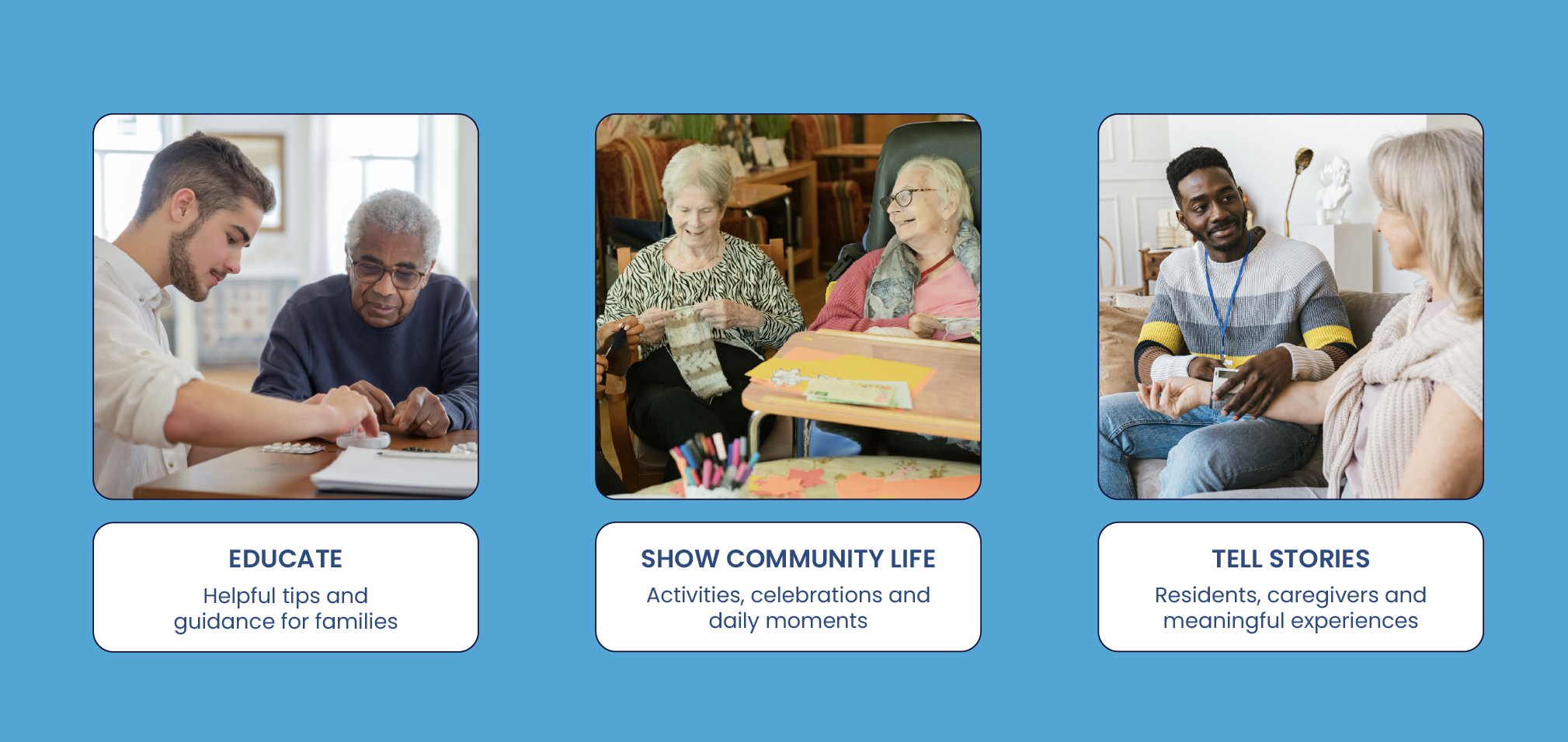
Types of Content That Build Trust

In senior living marketing, the goal is not only visibility but emotional reassurance.

The most effective content typically falls into three categories:

1) Daily Live Content

This type of content helps families visualize what their loved one’s life might look like.

Examples include:

  • Photos of residents participating in activities
  • Short videos from events or celebrations
  • Moments from group meals or social gatherings
  • Seasonal decorations or community traditions

2) Educational Content

When communities provide helpful information, they become trusted resources rather than just service providers.

Examples include:

  • Tips for recognizing when a loved one may need assisted living
  • Guidance on talking with parents about senior care
  • Information about memory care and cognitive health
  • Advice for supporting aging parents

3) Human Story Content

Stories connect emotionally and remind families that behind every facility are real people providing compassionate care.

Examples include:

  • Resident milestones and celebrations
  • Staff spotlights and caregiver stories
  • Family testimonials
  • Community achievements

The Platforms That Matter Most

Senior living communities do not need to be active on every social platform. Instead, focus on the channels where families are already searching for information.

1) Facebook

Facebook remains one of the most important platforms for senior living marketing. Many adult children researching care options fall within the primary demographic of Facebook users.

It works well for sharing community updates, events, photos and educational posts.

2) Instagram

Instagram is ideal for visual storytelling. Short videos, photos and behind the scenes content help showcase the atmosphere of the community.

It also helps humanize the brand by showing staff personalities and everyday interactions.

3) Linkedin

LinkedIn is valuable for establishing professional credibility. Sharing industry insights, staff achievements and educational content helps position the senior living center as a trusted authority in care.

It also strengthens connections with healthcare professionals, referral partners and the broader senior care community.

Consistency Over Perfection

One of the most common challenges senior living communities face with social media is consistency.

Many teams feel pressure to create perfect posts, professional photography or elaborate video content. In reality, authenticity often performs better than overly polished material.

Families want to see real moments.

Posting consistently, even with simple content, creates a clearer picture of daily life in your community.

Consistency builds familiarity, and familiarity builds trust.

For senior living centers, social media should not feel like another marketing obligation. It is an opportunity to open a window into the community. Families want to see real moments, genuine care and the environment their loved ones could soon call home.

Common Social Media Questions from Families

Families researching senior living options often look for answers to similar questions online. A strong social media strategy can help address these concerns early.

  • How can I know if a community is right for my parent

Seeing consistent content about activities, care philosophy and resident life helps families imagine their loved one in that environment.

  • How involved and attentive is the staff

Staff highlights, caregiver interviews and behind the scenes content demonstrate the culture of care within the community.

  • What does daily life actually look like

Daily life content provides transparency that brochures and advertisements cannot capture.

When social media answers these questions naturally through content, families feel more confident reaching out.

How a Social Media Strategy Supports Senior Living Growth

For senior living communities, social media is not just about visibility. It supports long term marketing goals.

A strong strategy can help:

  • Increase brand awareness within the local community
  • Build credibility with families researching care options
  • Strengthen relationships with current residents and families
  • Drive website visits and tour inquiries

Over time, consistent content creates a digital footprint that reflects the community’s culture, values and commitment to care.

At Golden Chapter Marketing, we help senior living communities create social media strategies that build trust with families and increase tour inquiries. Through thoughtful storytelling, strategic content planning and consistent posting, we help communities showcase the care, lifestyle and values that make them unique.

AI SEO For Senior Living: GEO And AEO For AI Answers And Voice Search

Families are not just scrolling through ten blue links anymore. They are getting instant summaries, AI-generated “best options,” and spoken answers from voice assistants. That shift changes how your community gets discovered, compared, and contacted. AI SEO for senior living is the work of making sure your website is clear, trustworthy, and easy for both people and AI systems to understand, so you can show up when families ask high-intent questions.

At Golden Chapter Marketing, we build modern senior living marketing systems that are easy to understand, grounded in integrity, and focused on real outcomes like calls, tours, and move-ins.

What GEO And AEO Mean For Senior Living

You will hear a lot of new acronyms right now, so here is the plain-language version.

AI SEO
  • AEO (Answer Engine Optimization) focuses on getting your community included in direct answers, like “What is memory care?” or “How much does assisted living cost in my area?”
  • GEO (Generative Engine Optimization) focuses on getting your site referenced in AI-generated summaries, like Google AI Overviews and other AI search experiences. Google has published guidance for site owners on AI features and how to approach your content’s inclusion.

In practice, both GEO and AEO start with the same foundation: a website that explains your care options clearly, proves trust, and makes next steps simple.

How Families Research Senior Living Online Now

Senior living decisions are emotional and time-sensitive. Families often search in moments of stress, and their questions are specific:

  • Assisted living vs memory care, what is the difference?”
  • “Is there medication management?”
  • “What does respite care include?”
  • “How soon can we tour?”
  • “What is the monthly cost range near me?”

AI search experiences tend to reward sites that answer these questions plainly, with strong structure and reliable signals. That is why AI SEO for senior living is not about chasing trends. It is about making your website more helpful and more understandable.

What Helps A Community Show Up In AI Answers

AI systems pull from sources they can interpret quickly and trust. For senior living, the strongest signals usually come from a combination of clarity, authority, and consistency.

Clarity: Your Site Has To Be Easy To Parse

If a page tries to cover everything at once, AI and humans both get confused. Communities do better when they have dedicated pages that match real intent, such as:

  • Assisted Living
  • Memory Care
  • Independent Living
  • Respite Care
  • Floor Plans
  • Pricing Approach and What Impacts Cost
  • Admissions Process and Timeline
  • Dining, Activities, and Care Team

This is where a senior living website content strategy matters. You are not adding pages for “SEO.” You are building a library of answers that admissions teams give every day.

Authority: Your Content Needs Proof And Specificity

Generic wording blends into the background. AI summaries tend to favor content that includes specifics like services, staff credentials, what is included, and what families should expect. This is also where brand trust comes in, which is why Golden Chapter pairs search strategy with branding for senior living so your messaging sounds human, consistent, and confident.

Consistency: Local And Contact Signals Must Match Everywhere

If your name, address, phone number, hours, and location details differ across your website and listings, you create doubt. Consistency supports both senior living SEO and AI-driven results because it reduces ambiguity about who you are and where you serve.

The Website Updates That Usually Move The Needle Most

If you only do a few things this quarter, focus on the upgrades that improve both visibility and conversions.

1) Build Service Pages That Map To Real Questions

For AI SEO for senior living, service pages work best when they are written like an admissions conversation:

  • Who the service is for
  • What is included, in plain language
  • What a typical day looks like
  • Safety, staffing, and support highlights
  • What families worry about most, answered directly
  • Clear next steps: call, schedule a tour, request pricing

This kind of structure supports both GEO for senior living and AEO, because it is easy for AI systems to extract and summarize.

2) Improve Site Structure So AI Can Understand The Hierarchy

Simple navigation and accurate headings ensure your site remains user-friendly. By dedicating each page to a single main topic, you create a clean structure that helps AI search engines “quote” your content as the definitive answer for senior living questions.

3) Add Helpful Structured Data Where It Fits

Structured data is not magic, but it helps search engines better understand what a page is about and can support eligibility for enhanced search displays. Google provides structured data documentation and guidelines for site owners.

For senior living communities, common opportunities include organization details, locations, FAQ sections, and articles. The key is accuracy. Mark up what is truly on the page.

4) Strengthen Trust Signals On Every High-Intent Page

Families are making a major decision. Trust signals should be visible without forcing them to hunt:

  • Real photos that match the community
  • Clear contact options
  • Reviews and testimonials (where appropriate)
  • Licensing and accreditation information (if applicable)
  • Transparent “what happens next” steps

These upgrades help AI visibility, but they also help the human being who is deciding whether to call you.

5) Make Pages Fast, Accessible, And Easy For Seniors To Use

If your site is hard to read, slow, or confusing on mobile, you lose the inquiry before it happens. Accessibility and usability are a direct growth lever, and they are a core part of our approach to website design for senior living.

senior living SEO

Voice Search: Why It Connects Naturally To AEO

Voice searches are often longer and more conversational, which makes them similar to AI answer prompts. People say things like “What is the best senior living option for my dad with memory loss?” instead of typing “memory care options.”

To earn those answers:

  • Write in natural language, not marketing slogans
  • Use short, clear definitions early on key pages
  • Include FAQ sections that match how families speak
  • Make it easy to contact you from mobile

For more context on voice search optimization, Search Engine Land has a practical overview of voice search and how it impacts SEO strategy.

How To Show Up In ChatGPT For Senior Living

When people ask “how to show up in ChatGPT for senior living,” what they usually mean is: “How do we become one of the sources AI tools trust enough to reference?”

The best answer is consistent with everything above:

  • Publish clear, service-specific pages
  • Build a strong internal linking structure so AI can find the right page
  • Maintain consistent local signals
  • Keep content accurate, specific, and updated
  • Earn authority with helpful educational content

Search platforms and answer engines do not all work the same way, but modern SEO foundations still matter. Search Engine Land has also discussed how different AI engines generate and cite answers, and why “being cited” can differ from traditional rankings.

Where Golden Chapter Marketing Fits In

Senior living is not just another industry vertical to us. We built Golden Chapter Marketing to bring senior living marketing into 2026 with systems that are modern, measurable, and easy to understand.

A Simple Way To Start This Month

If you are unsure where to begin, do this first:

  • Pick your top 3 services (for example, Assisted Living, Memory Care, Respite Care)
  • Review each service page and rewrite it so it answers real questions in plain language
  • Add an FAQ section to each page based on what admissions hears every week

That is the core of AI SEO for senior living done the right way: clear answers, strong trust, and a website that supports confident decisions.

Local SEO for Senior Living: Ranking Communities in Competitive Markets

When families begin looking for senior living, they rarely start with a phone call. They start with a search. They compare communities, read reviews, scan photos, visit websites, and try to figure out which option feels trustworthy enough to take the next step.

That is exactly why local SEO for senior living matters. It helps your community appear when people nearby are actively researching care, housing, support, and lifestyle options. For operators and marketing leaders, it is not just about traffic. It is about showing up at the right moment, building confidence fast, and turning visibility into inquiries, tours, and occupancy.

What Local SEO Means for Senior Living

In plain language, local SEO helps your community appear in search results when someone looks for options in a specific area. That may include searches like “assisted living near me,” “memory care in Dallas,” or “independent living community in Scottsdale.”

For senior living, local SEO sits at the intersection of search visibility, trust, and user experience. It influences whether families can find you on Google, whether your Google Business Profile stands out, and whether your website answers the real questions people have before they ever speak with your team.

local-SEO-senior-living

Why It Matters More Than Ever

Families are doing deep research before they reach out. The National Institute on Aging notes that choosing a long-term care facility can be difficult and that families often need to compare options, services, and support carefully. At the same time, Pew Research Center reports that even among adults 65 and older, internet use remains widespread, which reinforces how digital research now shapes real-world decisions.

That shift changes the role of marketing for senior living communities.

Strong local SEO for senior living helps you:

  • Reach families earlier in their search
  • Show up in map results and localized searches
  • Build trust before the first conversation
  • Support tours, calls, and form submissions
  • Improve the quality of inquiries, not just the quantity

For communities in competitive markets, that difference matters.

How SEO Supports Inquiries, Tours, and Occupancy

SEO can sound abstract until you connect it to outcomes. In senior living, the path is usually straightforward.

A family member searches for care in your market. They see a few local options. They click the communities that look credible, close, and relevant. Then they decide which ones are worth contacting.

That means SEO supports occupancy in practical ways:

  1. It Helps You Get Found

If your community does not rank for the services and locations you actually offer, you miss high intent searchers. Google says local results are influenced by relevance, distance, and prominence. In other words, your community needs to match what people are searching for, clearly represent where you serve, and build enough trust signals to stand out.

  1. It Builds Confidence Quickly

Families are often evaluating multiple communities at once. A strong search presence tells them your brand is established, active, and credible. Clear titles, accurate listings, real reviews, and useful location pages all reduce friction.

  1. It Improves Conversion Quality

Good SEO is not about attracting everyone. It is about attracting the right people. When your pages align with services, care levels, amenities, and local intent, the inquiries that come in are more likely to be relevant to your admissions team.

That is why many of the best senior living marketing strategies begin with search intent.

What an Effective Senior Living SEO Strategy Includes

The good news is that SEO does not need to feel mysterious. A good strategy is structured, repeatable, and understandable.

Here are the building blocks.

local-SEO-for-senior-living

A Clear Local Keyword Strategy

Your community should have pages and content built around the real ways people search. That includes location-based phrases, service-specific terms, and intent-driven searches.

Examples might include:

  • Assisted living in your city
  • Memory care near a specific neighborhood
  • Senior living community in a metro area
  • Independent living with local modifiers
  • Questions families ask before scheduling a tour

This is one reason senior living marketing often falls flat when it stays too broad. General branding language may sound polished, but it will not rank well if it does not match how people actually search.

Optimized Google Business Profile

A verified and well maintained Google Business Profile is one of the most important local SEO assets you have. Google states that complete and accurate business information helps improve visibility in local search results, and verified profiles help businesses show up in Maps and Search.

For senior living communities, that means your profile should include:

  • Correct name, address, and phone number
  • Consistent service categories
  • Updated hours and contact information
  • Recent photos
  • Thoughtful review management
  • Clear service descriptions

This is often one of the fastest ways to strengthen local SEO for senior living without overcomplicating the process.

Service And Location Pages That Answer Real Questions

Your website needs more than a homepage. It should help families understand what you offer, who it is for, where you are, and what makes your community a fit.

That can include pages for:

  • Assisted living
  • Memory care
  • Independent living
  • Respite care
  • Specific cities, neighborhoods, or metro areas
  • Lifestyle, amenities, dining, or care philosophy

The best pages do not just chase keywords. They reduce uncertainty. They answer the questions your admissions team hears every day.

Reviews And Reputation Signals

In local search, reputation matters. Families read reviews because they want social proof from people who have already had an experience with your community.

That does not mean chasing a perfect score or flooding platforms with requests. It means building a consistent review process, responding thoughtfully, and making sure your reputation reflects the lived experience you want prospective residents and families to understand.

This is one of the clearest ways SEO and conversion work together. Reviews influence visibility, but they also influence whether someone feels safe taking the next step.

Technical Foundations That Support Visibility

You do not need to turn into a developer to understand the basics. Technical SEO simply means making your website easier for search engines and users to navigate.

That includes:

  • Fast page load times
  • Mobile-friendly layouts
  • Clear site structure
  • Proper title tags and headings
  • Indexable pages
  • Clean internal linking

If your site is hard to use, families notice. If Google has trouble understanding your content, rankings suffer. Technical work may happen behind the scenes, but its impact shows up in visibility and usability.

Content That Matches Family Search Intent

Educational content helps your community rank for earlier-stage searches and build trust before a prospect is ready to call.

That may include blog topics such as:

  • What is the difference between assisted living and memory care
  • How to compare senior living communities in your city
  • What families should ask on a tour
  • Signs it may be time to consider more support
  • Costs, lifestyle, and care planning questions

This is where senior living marketing agency support can make a big difference. The right team helps translate complex marketing work into content that is useful, empathetic, and aligned with revenue goals.

Why Local SEO Often Feels Frustrating

Many communities know they need SEO, but they still feel unsure what it is doing.

That usually happens for a few reasons:

  • Reporting focuses on vanity metrics instead of real leads
  • Agencies speak in jargon instead of plain language
  • Strategy gets disconnected from occupancy goals
  • Website updates, listings, content, and conversion paths are managed in silos

That disconnect is expensive. You may be investing in search visibility without understanding how it affects calls, form fills, tours, or move-ins.

A stronger approach is simpler. Focus on what can be tracked. Prioritize what families actually need. Make every digital touchpoint easier to understand.

That is how SEO helps improve senior living occupancy over time.

What Makes A Senior Living-Focused Approach Different

Senior living is not just another vertical. The audience is different. The decision cycle is different. The emotional context is different.

Families are often carrying urgency, stress, uncertainty, and guilt while trying to make a careful decision. Your digital presence should respect that.

That means effective local SEO for senior living should not feel robotic or overly technical. It should feel human.

A senior living-focused approach usually works best when it combines:

  • Search strategy tied to service and geographic intent
  • Content that answers real family concerns
  • Website UX that feels calm and easy to navigate
  • Local optimization that supports maps, listings, and reviews
  • Reporting that connects visibility to inquiries and tours

This is also why the best senior living marketing strategies balance empathy with performance. Families need clarity. Leadership teams need results. Good SEO should support both.

local-SEO-for-senior-livin

How Golden Chapter Makes SEO More Understandable

Golden Chapter Marketing positions itself around clarity, empathy, and trackable performance. Rather than turning SEO into a black box, the goal is to make it understandable, measurable, and connected to outcomes that matter for senior living communities. That includes visibility, qualified inquiries, and the digital experience families have before they ever speak with your team.

That matters because many operators are not looking for more noise. They are looking for a partner who can simplify what matters and help increase senior living occupancy with a repeatable process.

For communities that want a clearer path forward, Golden Chapter’s work starts with the fundamentals:

  • Understand how families search in your market
  • Improve the local signals that influence visibility
  • Build pages that answer real questions
  • Connect SEO efforts to trackable lead actions
  • Keep reporting focused on meaningful outcomes
Request a Free Consult Icon Request a free consult