
Social Media Strategy for Senior Living Centers: How to Build Trust with Families Online

If you’re wondering whether investing in a social media strategy is worth it, you’re not alone. In a world where paid advertising dominates most marketing strategies, the power of organic content is often overlooked.

Social media creates something that advertising alone cannot: trust.

Families looking for senior living options are not just looking for facts, pricing or amenities. They are looking for reassurance that they are making the right decision for someone they love. A thoughtful social media strategy allows senior living centers to showcase their community, values, and quality of care in a way that builds that trust.

What a Social Media Strategy actually means

A social media strategy is an action oriented plan outlining how an organization or individual uses social media to achieve specific business goals.

It acts as a roadmap for:

  • Content creation
  • Platform selection
  • Audience engagement

This ensures all efforts are consistent, measurable and aligned with overall business objectives.

Without a strategy, content often feels random. With a strategy, every post serves a purpose and moves families closer to choosing your community.

Why Social Media Matters in Senior Living Marketing

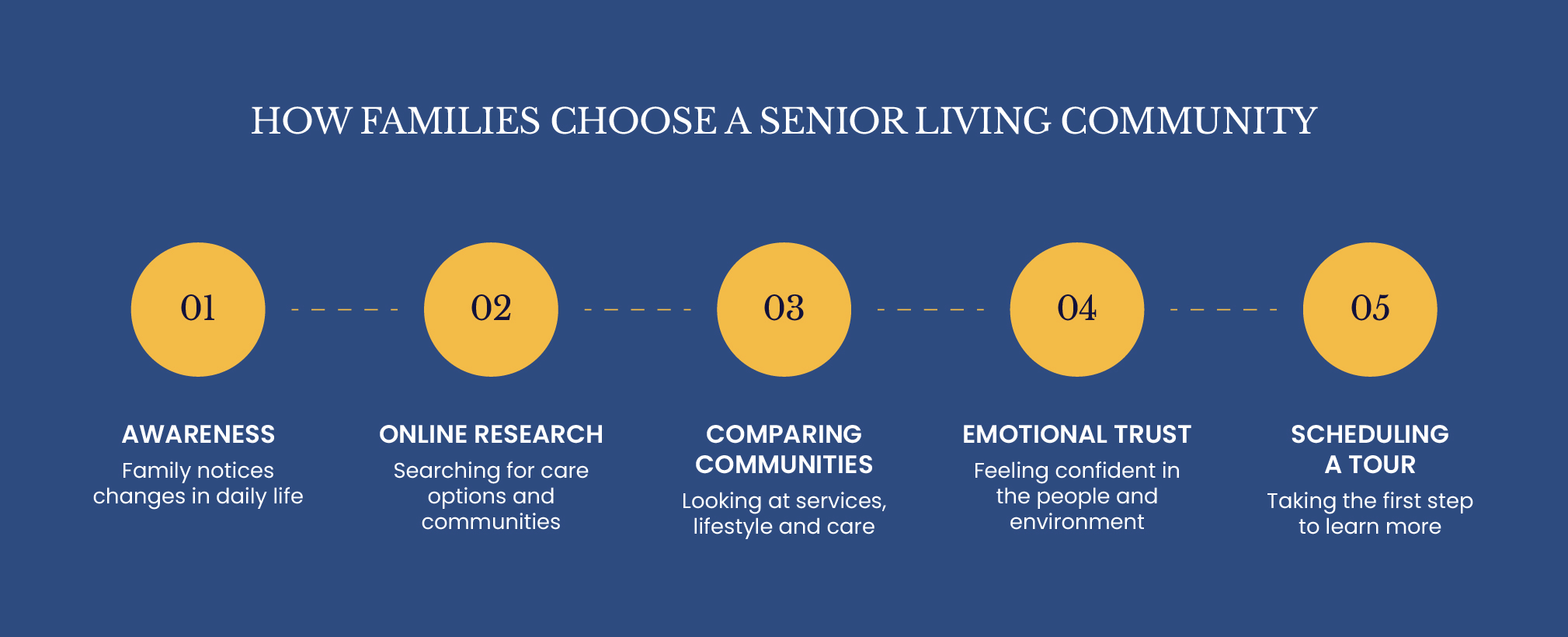
Choosing a senior living community is one of the most emotional decisions families make. They are looking for someone to trust their loved ones. That is why children often spend weeks or months researching options before contacting a facility.

During that process, they are looking for more than brochures or pricing sheets. They want to understand the environment their loved one might live in. And this is where social media can help.

According to Pew Research, over 70% of adults use social media, and many rely on it to research businesses and services before making decisions. For senior living centers, this means your social channels often become the first real look families get at your community.

Social media helps families answer questions like:

  • What does daily life look like here
  • Do residents seem happy and engaged
  • What type of activities are offered
  • How do staff members interact with residents
  • What values guide the community

Seeing these things consistently builds familiarity and confidence before a family ever schedules a tour.
Types of Content That Build Trust

In senior living marketing, the goal is not only visibility but emotional reassurance.

The most effective content typically falls into three categories:

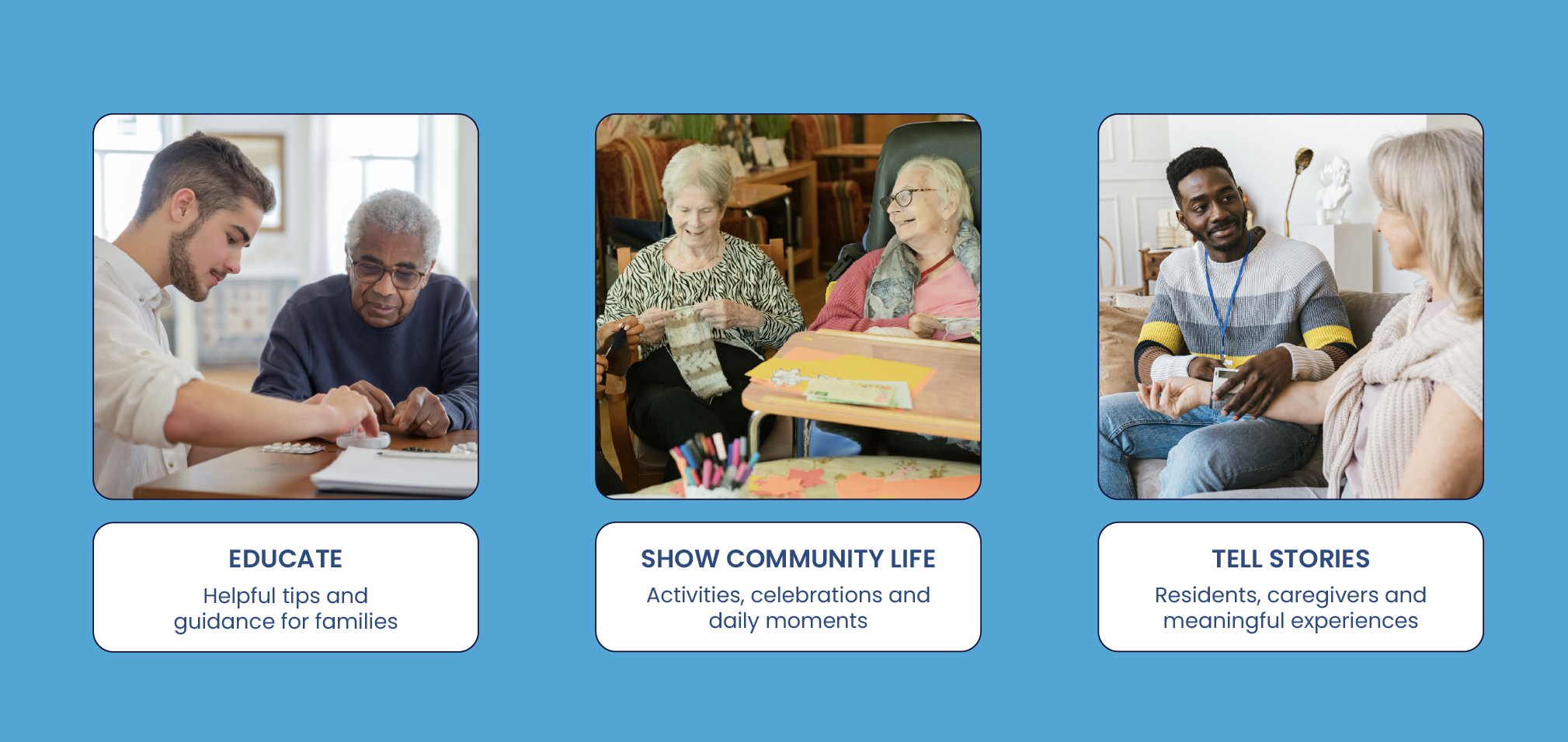
1) Daily Live Content

This type of content helps families visualize what their loved one’s life might look like.

Examples include:

  • Photos of residents participating in activities
  • Short videos from events or celebrations
  • Moments from group meals or social gatherings
  • Seasonal decorations or community traditions

2) Educational Content

When communities provide helpful information, they become trusted resources rather than just service providers.

Examples include:

  • Tips for recognizing when a loved one may need assisted living
  • Guidance on talking with parents about senior care
  • Information about memory care and cognitive health
  • Advice for supporting aging parents

3) Human Story Content

Stories connect emotionally and remind families that behind every facility are real people providing compassionate care.

Examples include:

  • Resident milestones and celebrations
  • Staff spotlights and caregiver stories
  • Family testimonials
  • Community achievements

The Platforms That Matter Most

Senior living communities do not need to be active on every social platform. Instead, focus on the channels where families are already searching for information.

1) Facebook

Facebook remains one of the most important platforms for senior living marketing. Many adult children researching care options fall within the primary demographic of Facebook users.

It works well for sharing community updates, events, photos and educational posts.

2) Instagram

Instagram is ideal for visual storytelling. Short videos, photos and behind the scenes content help showcase the atmosphere of the community.

It also helps humanize the brand by showing staff personalities and everyday interactions.

3) Linkedin

LinkedIn is valuable for establishing professional credibility. Sharing industry insights, staff achievements and educational content helps position the senior living center as a trusted authority in care.

It also strengthens connections with healthcare professionals, referral partners and the broader senior care community.

Consistency Over Perfection

One of the most common challenges senior living communities face with social media is consistency.

Many teams feel pressure to create perfect posts, professional photography or elaborate video content. In reality, authenticity often performs better than overly polished material.

Families want to see real moments.

Posting consistently, even with simple content, creates a clearer picture of daily life in your community.

Consistency builds familiarity, and familiarity builds trust.

For senior living centers, social media should not feel like another marketing obligation. It is an opportunity to open a window into the community. Families want to see real moments, genuine care and the environment their loved ones could soon call home.

Common Social Media Questions from Families

Families researching senior living options often look for answers to similar questions online. A strong social media strategy can help address these concerns early.

  • How can I know if a community is right for my parent

Seeing consistent content about activities, care philosophy and resident life helps families imagine their loved one in that environment.

  • How involved and attentive is the staff

Staff highlights, caregiver interviews and behind the scenes content demonstrate the culture of care within the community.

  • What does daily life actually look like

Daily life content provides transparency that brochures and advertisements cannot capture.

When social media answers these questions naturally through content, families feel more confident reaching out.

How a Social Media Strategy Supports Senior Living Growth

For senior living communities, social media is not just about visibility. It supports long term marketing goals.

A strong strategy can help:

  • Increase brand awareness within the local community
  • Build credibility with families researching care options
  • Strengthen relationships with current residents and families
  • Drive website visits and tour inquiries

Over time, consistent content creates a digital footprint that reflects the community’s culture, values and commitment to care.

At Golden Chapter Marketing, we help senior living communities create social media strategies that build trust with families and increase tour inquiries. Through thoughtful storytelling, strategic content planning and consistent posting, we help communities showcase the care, lifestyle and values that make them unique.


AI SEO For Senior Living: GEO And AEO For AI Answers And Voice Search

Families are not just scrolling through ten blue links anymore. They are getting instant summaries, AI-generated “best options,” and spoken answers from voice assistants. That shift changes how your community gets discovered, compared, and contacted. AI SEO for senior living is the work of making sure your website is clear, trustworthy, and easy for both people and AI systems to understand, so you can show up when families ask high-intent questions.

At Golden Chapter Marketing, we build modern senior living marketing systems that are easy to understand, grounded in integrity, and focused on real outcomes like calls, tours, and move-ins.

What GEO And AEO Mean For Senior Living

You will hear a lot of new acronyms right now, so here is the plain-language version.

AI SEO
  • AEO (Answer Engine Optimization) focuses on getting your community included in direct answers, like “What is memory care?” or “How much does assisted living cost in my area?”
  • GEO (Generative Engine Optimization) focuses on getting your site referenced in AI-generated summaries, like Google AI Overviews and other AI search experiences. Google has published guidance for site owners on AI features and how to approach your content’s inclusion.

In practice, both GEO and AEO start with the same foundation: a website that explains your care options clearly, proves trust, and makes next steps simple.

How Families Research Senior Living Online Now

Senior living decisions are emotional and time-sensitive. Families often search in moments of stress, and their questions are specific:

  • Assisted living vs memory care, what is the difference?”
  • “Is there medication management?”
  • “What does respite care include?”
  • “How soon can we tour?”
  • “What is the monthly cost range near me?”

AI search experiences tend to reward sites that answer these questions plainly, with strong structure and reliable signals. That is why AI SEO for senior living is not about chasing trends. It is about making your website more helpful and more understandable.

What Helps A Community Show Up In AI Answers

AI systems pull from sources they can interpret quickly and trust. For senior living, the strongest signals usually come from a combination of clarity, authority, and consistency.

Clarity: Your Site Has To Be Easy To Parse

If a page tries to cover everything at once, AI and humans both get confused. Communities do better when they have dedicated pages that match real intent, such as:

  • Assisted Living
  • Memory Care
  • Independent Living
  • Respite Care
  • Floor Plans
  • Pricing Approach and What Impacts Cost
  • Admissions Process and Timeline
  • Dining, Activities, and Care Team

This is where a senior living website content strategy matters. You are not adding pages for “SEO.” You are building a library of answers that admissions teams give every day.

Authority: Your Content Needs Proof And Specificity

Generic wording blends into the background. AI summaries tend to favor content that includes specifics like services, staff credentials, what is included, and what families should expect. This is also where brand trust comes in, which is why Golden Chapter pairs search strategy with branding for senior living so your messaging sounds human, consistent, and confident.

Consistency: Local And Contact Signals Must Match Everywhere

If your name, address, phone number, hours, and location details differ across your website and listings, you create doubt. Consistency supports both senior living SEO and AI-driven results because it reduces ambiguity about who you are and where you serve.

The Website Updates That Usually Move The Needle Most

If you only do a few things this quarter, focus on the upgrades that improve both visibility and conversions.

1) Build Service Pages That Map To Real Questions

For AI SEO for senior living, service pages work best when they are written like an admissions conversation:

  • Who the service is for
  • What is included, in plain language
  • What a typical day looks like
  • Safety, staffing, and support highlights
  • What families worry about most, answered directly
  • Clear next steps: call, schedule a tour, request pricing

This kind of structure supports both GEO for senior living and AEO, because it is easy for AI systems to extract and summarize.

2) Improve Site Structure So AI Can Understand The Hierarchy

Simple navigation and accurate headings ensure your site remains user-friendly. By dedicating each page to a single main topic, you create a clean structure that helps AI search engines “quote” your content as the definitive answer for senior living questions.

3) Add Helpful Structured Data Where It Fits

Structured data is not magic, but it helps search engines better understand what a page is about and can support eligibility for enhanced search displays. Google provides structured data documentation and guidelines for site owners.

For senior living communities, common opportunities include organization details, locations, FAQ sections, and articles. The key is accuracy. Mark up what is truly on the page.

4) Strengthen Trust Signals On Every High-Intent Page

Families are making a major decision. Trust signals should be visible without forcing them to hunt:

  • Real photos that match the community
  • Clear contact options
  • Reviews and testimonials (where appropriate)
  • Licensing and accreditation information (if applicable)
  • Transparent “what happens next” steps

These upgrades help AI visibility, but they also help the human being who is deciding whether to call you.

5) Make Pages Fast, Accessible, And Easy For Seniors To Use

If your site is hard to read, slow, or confusing on mobile, you lose the inquiry before it happens. Accessibility and usability are a direct growth lever, and they are a core part of our approach to website design for senior living.

senior living SEO

Voice Search: Why It Connects Naturally To AEO

Voice searches are often longer and more conversational, which makes them similar to AI answer prompts. People say things like “What is the best senior living option for my dad with memory loss?” instead of typing “memory care options.”

To earn those answers:

  • Write in natural language, not marketing slogans
  • Use short, clear definitions early on key pages
  • Include FAQ sections that match how families speak
  • Make it easy to contact you from mobile

For more context on voice search optimization, Search Engine Land has a practical overview of voice search and how it impacts SEO strategy.

How To Show Up In ChatGPT For Senior Living

When people ask “how to show up in ChatGPT for senior living,” what they usually mean is: “How do we become one of the sources AI tools trust enough to reference?”

The best answer is consistent with everything above:

  • Publish clear, service-specific pages
  • Build a strong internal linking structure so AI can find the right page
  • Maintain consistent local signals
  • Keep content accurate, specific, and updated
  • Earn authority with helpful educational content

Search platforms and answer engines do not all work the same way, but modern SEO foundations still matter. Search Engine Land has also discussed how different AI engines generate and cite answers, and why “being cited” can differ from traditional rankings.

Where Golden Chapter Marketing Fits In

Senior living is not just another industry vertical to us. We built Golden Chapter Marketing to bring senior living marketing into 2026 with systems that are modern, measurable, and easy to understand.

A Simple Way To Start This Month

If you are unsure where to begin, do this first:

  • Pick your top 3 services (for example, Assisted Living, Memory Care, Respite Care)
  • Review each service page and rewrite it so it answers real questions in plain language
  • Add an FAQ section to each page based on what admissions hears every week

That is the core of AI SEO for senior living done the right way: clear answers, strong trust, and a website that supports confident decisions.

Local SEO for Senior Living: Ranking Communities in Competitive Markets

When families begin looking for senior living, they rarely start with a phone call. They start with a search. They compare communities, read reviews, scan photos, visit websites, and try to figure out which option feels trustworthy enough to take the next step.

That is exactly why local SEO for senior living matters. It helps your community appear when people nearby are actively researching care, housing, support, and lifestyle options. For operators and marketing leaders, it is not just about traffic. It is about showing up at the right moment, building confidence fast, and turning visibility into inquiries, tours, and occupancy.

What Local SEO Means for Senior Living

In plain language, local SEO helps your community appear in search results when someone looks for options in a specific area. That may include searches like “assisted living near me,” “memory care in Dallas,” or “independent living community in Scottsdale.”

For senior living, local SEO sits at the intersection of search visibility, trust, and user experience. It influences whether families can find you on Google, whether your Google Business Profile stands out, and whether your website answers the real questions people have before they ever speak with your team.

local-SEO-senior-living

Why It Matters More Than Ever

Families are doing deep research before they reach out. The National Institute on Aging notes that choosing a long-term care facility can be difficult and that families often need to compare options, services, and support carefully. At the same time, Pew Research Center reports that even among adults 65 and older, internet use remains widespread, which reinforces how digital research now shapes real-world decisions.

That shift changes the role of marketing for senior living communities.

Strong local SEO for senior living helps you:

  • Reach families earlier in their search
  • Show up in map results and localized searches
  • Build trust before the first conversation
  • Support tours, calls, and form submissions
  • Improve the quality of inquiries, not just the quantity

For communities in competitive markets, that difference matters.

How SEO Supports Inquiries, Tours, and Occupancy

SEO can sound abstract until you connect it to outcomes. In senior living, the path is usually straightforward.

A family member searches for care in your market. They see a few local options. They click the communities that look credible, close, and relevant. Then they decide which ones are worth contacting.

That means SEO supports occupancy in practical ways:

  1. It Helps You Get Found

If your community does not rank for the services and locations you actually offer, you miss high intent searchers. Google says local results are influenced by relevance, distance, and prominence. In other words, your community needs to match what people are searching for, clearly represent where you serve, and build enough trust signals to stand out.

  1. It Builds Confidence Quickly

Families are often evaluating multiple communities at once. A strong search presence tells them your brand is established, active, and credible. Clear titles, accurate listings, real reviews, and useful location pages all reduce friction.

  1. It Improves Conversion Quality

Good SEO is not about attracting everyone. It is about attracting the right people. When your pages align with services, care levels, amenities, and local intent, the inquiries that come in are more likely to be relevant to your admissions team.

That is why many of the best senior living marketing strategies begin with search intent.

What an Effective Senior Living SEO Strategy Includes

The good news is that SEO does not need to feel mysterious. A good strategy is structured, repeatable, and understandable.

Here are the building blocks.

local-SEO-for-senior-living

A Clear Local Keyword Strategy

Your community should have pages and content built around the real ways people search. That includes location-based phrases, service-specific terms, and intent-driven searches.

Examples might include:

  • Assisted living in your city
  • Memory care near a specific neighborhood
  • Senior living community in a metro area
  • Independent living with local modifiers
  • Questions families ask before scheduling a tour

This is one reason senior living marketing often falls flat when it stays too broad. General branding language may sound polished, but it will not rank well if it does not match how people actually search.

Optimized Google Business Profile

A verified and well maintained Google Business Profile is one of the most important local SEO assets you have. Google states that complete and accurate business information helps improve visibility in local search results, and verified profiles help businesses show up in Maps and Search.

For senior living communities, that means your profile should include:

  • Correct name, address, and phone number
  • Consistent service categories
  • Updated hours and contact information
  • Recent photos
  • Thoughtful review management
  • Clear service descriptions

This is often one of the fastest ways to strengthen local SEO for senior living without overcomplicating the process.

Service And Location Pages That Answer Real Questions

Your website needs more than a homepage. It should help families understand what you offer, who it is for, where you are, and what makes your community a fit.

That can include pages for:

  • Assisted living
  • Memory care
  • Independent living
  • Respite care
  • Specific cities, neighborhoods, or metro areas
  • Lifestyle, amenities, dining, or care philosophy

The best pages do not just chase keywords. They reduce uncertainty. They answer the questions your admissions team hears every day.

Reviews And Reputation Signals

In local search, reputation matters. Families read reviews because they want social proof from people who have already had an experience with your community.

That does not mean chasing a perfect score or flooding platforms with requests. It means building a consistent review process, responding thoughtfully, and making sure your reputation reflects the lived experience you want prospective residents and families to understand.

This is one of the clearest ways SEO and conversion work together. Reviews influence visibility, but they also influence whether someone feels safe taking the next step.

Technical Foundations That Support Visibility

You do not need to turn into a developer to understand the basics. Technical SEO simply means making your website easier for search engines and users to navigate.

That includes:

  • Fast page load times
  • Mobile-friendly layouts
  • Clear site structure
  • Proper title tags and headings
  • Indexable pages
  • Clean internal linking

If your site is hard to use, families notice. If Google has trouble understanding your content, rankings suffer. Technical work may happen behind the scenes, but its impact shows up in visibility and usability.

Content That Matches Family Search Intent

Educational content helps your community rank for earlier-stage searches and build trust before a prospect is ready to call.

That may include blog topics such as:

  • What is the difference between assisted living and memory care
  • How to compare senior living communities in your city
  • What families should ask on a tour
  • Signs it may be time to consider more support
  • Costs, lifestyle, and care planning questions

This is where senior living marketing agency support can make a big difference. The right team helps translate complex marketing work into content that is useful, empathetic, and aligned with revenue goals.

Why Local SEO Often Feels Frustrating

Many communities know they need SEO, but they still feel unsure what it is doing.

That usually happens for a few reasons:

  • Reporting focuses on vanity metrics instead of real leads
  • Agencies speak in jargon instead of plain language
  • Strategy gets disconnected from occupancy goals
  • Website updates, listings, content, and conversion paths are managed in silos

That disconnect is expensive. You may be investing in search visibility without understanding how it affects calls, form fills, tours, or move-ins.

A stronger approach is simpler. Focus on what can be tracked. Prioritize what families actually need. Make every digital touchpoint easier to understand.

That is how SEO helps improve senior living occupancy over time.

What Makes A Senior Living-Focused Approach Different

Senior living is not just another vertical. The audience is different. The decision cycle is different. The emotional context is different.

Families are often carrying urgency, stress, uncertainty, and guilt while trying to make a careful decision. Your digital presence should respect that.

That means effective local SEO for senior living should not feel robotic or overly technical. It should feel human.

A senior living-focused approach usually works best when it combines:

  • Search strategy tied to service and geographic intent
  • Content that answers real family concerns
  • Website UX that feels calm and easy to navigate
  • Local optimization that supports maps, listings, and reviews
  • Reporting that connects visibility to inquiries and tours

This is also why the best senior living marketing strategies balance empathy with performance. Families need clarity. Leadership teams need results. Good SEO should support both.

local-SEO-for-senior-livin

How Golden Chapter Makes SEO More Understandable

Golden Chapter Marketing positions itself around clarity, empathy, and trackable performance. Rather than turning SEO into a black box, the goal is to make it understandable, measurable, and connected to outcomes that matter for senior living communities. That includes visibility, qualified inquiries, and the digital experience families have before they ever speak with your team.

That matters because many operators are not looking for more noise. They are looking for a partner who can simplify what matters and help increase senior living occupancy with a repeatable process.

For communities that want a clearer path forward, Golden Chapter’s work starts with the fundamentals:

  • Understand how families search in your market
  • Improve the local signals that influence visibility
  • Build pages that answer real questions
  • Connect SEO efforts to trackable lead actions
  • Keep reporting focused on meaningful outcomes

Memory Care SEO: Targeting Specialized Care Searches

When a family searches for memory care, they are rarely “just browsing.” These searches often come with urgency, worry, and a need for clarity around safety, dementia-specific support, and trust. That is exactly why memory care SEO matters. It helps your community show up for the specialized, high-intent searches families use, and it helps your website answer the questions that actually lead to calls, form submissions, and tours.

At Golden Chapter Marketing, our work centers on building digital experiences that feel intuitive, emotionally supportive, and easy to navigate for seniors and families making life-changing decisions.

Why Memory Care Searches Are Different Than General Senior Living Searches

Many senior living searches are exploratory. Memory care searches are often more specific and more anxious.

Families researching dementia care commonly want answers like:

  • What level of supervision is provided, and how is safety handled?
  • What does daily programming look like for cognitive support?
  • How does the community communicate with families?
  • What does the environment feel like, and is it designed for memory support?
  • How quickly can we get help?

That means SEO for memory care cannot be treated like a generic senior living content plan. If your pages are too vague, too salesy, or too difficult to navigate, you can still get clicks and lose inquiries.

This is where memory care marketing and SEO overlap. You are not only trying to rank. You are trying to build trust quickly.

memory care SEO services

The Keywords Families Actually Use When They Need Memory Care

Specialized searches tend to follow a few common patterns. You will see “near me” intent, location intent, and condition-specific intent all blending together. Examples include:

  • Memory care community near me
  • Memory care assisted living near me
  • Dementia care near me
  • Alzheimer’s care near me

A strong memory care SEO strategy maps these intents to the right pages, then builds clear content that matches the searcher’s real questions. You are not stuffing keywords. You are translating concern into clarity.

How To Win “Near Me” Searches With Local SEO For Memory Care

If you are competing with other communities in the same metro, local visibility becomes the difference between being considered and being invisible. Local SEO for memory care typically comes down to two big levers: local signals and on-page structure.

Local Signals That Support Rankings

Make sure your local presence is consistent and complete:

  • Accurate name, address, and phone number across the web
  • A well-built Google Business Profile with the right categories and services
  • Reviews that reflect memory-care-relevant experiences (safety, staff communication, compassion)
  • Location pages that clearly describe who you serve and where

Local visibility is about helping Google and families feel confident you are a real option nearby.

On-Page Structure That Supports “Near Me” Intent

Your website should make it obvious where you are and what you offer. A practical structure often includes:

  • A dedicated memory care page (not buried under a generic services page)
  • Location-specific memory care content when you serve multiple markets
  • Clear headings that match how families scan and decide
  • A fast path to contact, schedule a tour, or request pricing information

This is one of the most overlooked parts of memory care website SEO. Families do not want to dig. They want to understand, quickly.

What A High-Converting Memory Care Page Needs To Include

Ranking is only half the job. The other half is conversion, turning search traffic into qualified inquiries. A strong memory care page should read like a calm, helpful guide, not a brochure.

Here are the on-page elements that consistently reduce friction:

Clear Care Details, Not Generic Promises

Be specific about what you actually provide. For example:

  • Staff training and dementia-informed support (described plainly)
  • Supervision and safety protocols
  • Medication management approach (if applicable)
  • How you handle transitions and changing needs

Safety And Environment, Explained Simply

Families want to picture the daily reality. Help them do that with clear details like:

  • Secure layouts and monitored access
  • Wayfinding-friendly design
  • Calm spaces, lighting considerations, and routine-based flow
  • How you reduce confusion and support comfort

Programming And Routine That Feels Real

Memory care decisions are often about quality of life, not just medical needs. Explain:

  • What a typical day looks like
  • Cognitive and sensory programming approaches
  • Social engagement and family involvement
  • How you adapt activities by ability and interest

Next Steps That Feel Supportive, Not Pushy

Your calls-to-action should feel like help, not pressure:

  • “Talk With Our Team”
  • “Schedule A Tour”
  • “Ask About Availability”
  • “Get Answers About Cost And Care”

This is where memory care marketing strategies should be grounded in empathy. Clarity builds trust. Trust builds action.

SEO for memory care

Common SEO Mistakes That Quietly Reduce Memory Care Inquiries

If you are not getting the inquiry volume you want, it is often not one big issue. It is a handful of small gaps that add up.

Common problems include:

  • One generic senior living page trying to rank for everything
  • Thin memory care content that does not address dementia-specific questions
  • No clear location signals on the page
  • Overuse of the same phrases, making content feel repetitive or “written for Google”
  • Slow or confusing page experience on mobile

Good memory care SEO services fix these issues systematically, so you see measurable improvement instead of “more content” with no results.

How Golden Chapter Marketing Approaches Memory Care SEO

Golden Chapter Marketing exists to bring senior living marketing into 2026 with modern digital strategies, clear reporting, and systems that are easy to understand.

Our approach to senior living SEO and memory care SEO is designed to support occupancy goals by driving qualified visibility and improving conversion paths. We focus on real, trackable results and make digital marketing simple, because families are not the only ones who feel overwhelmed. Many community teams are, too.

Memory care SEO also works best when it is supported by the full digital experience. That is why our work often connects to:

A Simple Starting Plan You Can Use This Month

If you want a practical first step, use this quick plan:

  • Build or improve one dedicated memory care page with dementia-specific detail
  • Strengthen local signals and confirm your listings are consistent
  • Add sections that answer the top questions families ask before they call
  • Make the next step obvious and easy on every device
  • Track outcomes that matter: inquiries, calls, tour requests, and conversion rate

That is the foundation of memory care SEO, and it is how you turn specialized searches into families who feel confident reaching out.

Assisted Living vs Independent Living: SEO Content That Answers Real Questions

If you are comparing care options for a parent (or for yourself), you are not alone. Families often start with one search because it feels like the biggest fork in the road: assisted living vs independent living. And the truth is, you can do a lot of things “right” on a tour, but if your website does not explain the basics clearly, families keep scrolling.

This guide is here to make the comparison simple, human, and easy to talk about with siblings, doctors, and community teams.

Quick Definitions in Plain Language

What is Independent Living for Seniors?

Independent living is designed for older adults who can care for themselves, but want a simpler, maintenance-free lifestyle with community and amenities. Think: fewer chores, more social connection, and support services that are often optional.

What Does Assisted Living Include?

Assisted living is for older adults who want as much independence as possible, but need help with daily tasks like personal care, meals, medication support, housekeeping, and safety oversight. Many communities also offer activities and shared spaces.

If you have ever wondered if assisted living is the same as independent living, this is the simplest answer: independent living is mostly about lifestyle and convenience, while assisted living includes personal support and more hands-on help.

independent living vs assisted living cost

Assisted Living Compared to Independent Living

Here is a quick side-by-side that families actually use.

Daily Support and Staffing

  • Independent living: Residents generally manage daily routines on their own. Staff support is present, but not focused on personal care.
  • Assisted living: Staff can help with daily activities and provide regular check-ins, plus safety oversight.

Meals, Housekeeping, and Transportation

  • Independent living: Often includes dining and maintenance-free living, with add-ons available depending on the community.
  • Assisted living: Typically includes meals, housekeeping, and additional day-to-day help as part of the core offering.

Safety and Peace of Mind

  • Independent living: Usually includes safety features and staff availability, but not the same level of care support.
  • Assisted living: More structured support for daily needs, plus supervision and on-site staff coverage.

Privacy and Independence

  • Both options often provide private apartments or suites, but assisted living vs independent living differs in how much support is built into day-to-day life. Assisted living is designed to reduce risk when needs increase.

Independent Living vs Assisted Living Cost (high level)

Costs vary widely by state, apartment type, and what is included, so this is best handled as a checklist rather than a number.

When comparing independent living vs assisted living cost, ask what is bundled versus add-on:

  • Rent and utilities
  • Meals and dining plan
  • Housekeeping and laundry
  • Transportation
  • Activities and wellness programs
  • Personal care support (often the key difference)
  • Medication assistance (if offered)
  • Move-in fees, community fees, and contract terms

A helpful way to think about it: the more daily help that is included, the more the monthly cost tends to reflect that increased staffing and support.

assisted living compared to independent living

Signs it May Be Time to Move from Independent Living to Assisted Living

Families often ask when to move from independent living to assisted living. There is no perfect moment, but there are common signals:

  • Missed medications or confusion about schedules
  • Noticeable changes in hygiene, laundry, or nutrition
  • Falls, near-falls, or growing fear of being alone
  • Increasing reliance on family for basic daily tasks
  • A caregiver situation that is burning out
  • “Good days and hard days” starting to tilt toward hard days

If your family is debating assisted living vs independent living, it can help to name the real goal: safety and dignity, with the least amount of disruption.

Senior Living Levels of Care and Where These Fit

Many communities offer multiple senior living levels of care, and families do not always realize that options can be connected:

  • Independent living
  • Assisted living
  • Memory care (in some communities)
  • Skilled nursing (in some settings)

A tour is not just about today. It is also about how a community supports changing needs over time.

Questions to Ask on a Tour

Bring this checklist and use it to compare apples to apples. It is designed for both family decision-makers and community teams who want clearer conversations.

Care and Support

  • What help is available day to day, and what costs extra?
  • How do you assess a resident’s needs at move-in and over time?
  • How do you handle medication support?

Safety

  • What happens in an emergency, day or night?
  • How do you reduce fall risk and respond when falls happen?

Daily life

  • What is included in meals and dining?
  • What does a typical day look like for residents?
  • How do you support social connection for new residents?

Contracts and costs

  • What fees should we expect upfront?
  • What services are included, and what are add-ons?
  • How do rate increases work over time?

These questions also help answer the most common online searches, including “difference between assisted living and independent living” and “what does assisted living include,” which is exactly why this kind of page performs well in search.

difference between assisted living and independent living

Why this Topic Matters for Senior Living SEO

Families search assisted living vs independent living before they call. If your website answers the real questions clearly, you earn trust early, and you show up more often for high-intent searches.

At Golden Chapter Marketing, this is the core idea behind senior living SEO: build helpful content that matches real family search behavior, supports confident decisions, and connects visibility to outcomes leaders care about.

A Calmer Way to Compare Options

The best decision guide is the one that reduces uncertainty. If your family is weighing assisted living vs independent living, focus on what needs to be true for the next chapter to feel stable: safety, support, and a daily life that still feels like your loved one.

If you are touring communities, use the checklist above and ask the same questions everywhere. Clarity makes the next step easier.

What Is Senior Living SEO & Why It Matters for Your Community

If you are trying to improve occupancy, you are not just competing with the community down the street. You are competing with confusion, time pressure, and a family’s need to feel confident in a decision that carries real emotional weight.

That is where senior living SEO comes in.

Done well, senior living SEO helps your community show up when families search, feel reassured when they land on your site, and take the next step: call, request pricing, book a tour, or ask a question. It is not about chasing “rankings” for the sake of rankings. It is about being easy to find and easy to trust.

Senior Living SEO, Explained in Plain Language

Senior living SEO is the work of improving your website and online presence so your community appears in search results when families are looking for care options.

In practice, it means helping Google understand:

  • What you offer (assisted living, memory care, independent living, and more)
  • Where you are located and who you serve
  • Why your community is a good fit
  • What pages best answer common questions

Most importantly, it helps the right people find you at the right moment.

And that moment is happening online more than ever. Golden Chapter Marketing’s positioning is built around the reality that decision-makers are researching digitally first, and communities need modern visibility to compete.

senior living marketing strategies

Why Senior Living SEO Matters Now

Families rarely start with “Let’s call a community.”

They start with a search.

They look up location, care types, costs, reviews, floor plans, dining, activities, and what life actually feels like in your building. If your community does not show up, or your website feels unclear or hard to navigate, they move on.

This shift is exactly why senior living marketing is changing. Golden Chapter’s approach is built around moving beyond traditional tactics and building digital experiences that support confident decisions during major life transitions.

How Senior Living SEO Supports Inquiries, Tours, and Occupancy

SEO is not magic. It is a system that supports outcomes you can measure.

When senior living SEO is working, you typically see:

  • More qualified website visits from local, high-intent searches
  • More calls and form submissions that reflect real need (not random traffic)
  • More tour requests and better-prepared families when they arrive
  • Stronger trust signals before the first conversation
  • Momentum that supports efforts to increase senior living occupancy over time

If your current online performance feels like a mix of “some traffic” but not enough meaningful leads, you are not alone. Many communities are shown vanity metrics that do not connect to move-ins. Golden Chapter promises to report on what matters and focus on trackable ROI, not flashy dashboards.

What an Effective Senior Living SEO Strategy Includes

You do not need to be technical to understand what matters. A strong senior living SEO strategy usually includes five core pieces.

1) Clear Service and Location Clarity

Your website should make it obvious, quickly:

  • Which care levels do you offer
  • Who are you best suited for
  • Where you are located and what area you serve
  • How to take the next step

This is basic, but it is often the difference between “scrolling” and “calling.”

2) Helpful Pages that Match Real Searches

Families search in plain language. Your site should answer those plain-language questions.

Examples of high-intent topics:

  • Care types and what they include
  • What daily life looks like
  • What to expect during a tour
  • Common concerns families have when choosing care

This is where SEO and trust overlap. Your content should feel human, not salesy.

3) A Website Experience that is Easy to Use

SEO is not just keywords. If your site is slow, confusing, or hard to read, families will leave.

Golden Chapter explicitly prioritizes intuitive, accessible, user-centered website experiences, built for seniors and their families. That matters because your “digital front door” often shapes the first impression.

4) Credibility Signals that Reduce Uncertainty

In senior living, the decision is emotional. Families want to know they can trust you.

Credibility often comes from:

  • Clear messaging and consistent tone
  • Simple navigation
  • Photos and descriptions that feel real
  • Straightforward calls to action (call, schedule a tour, request info)

This is also where branding and web design support SEO. A trustworthy experience keeps people engaged, which supports performance over time.

5) Reporting Tied to Real Outcomes

This is the part most communities want, and rarely get.

SEO should connect to:

  • Calls
  • Form fills
  • Tour requests
  • Lead quality
  • Occupancy goals

Golden Chapter’s positioning is clear: no fluff, no vanity metrics, and reporting that helps you see the impact of marketing on revenue.

senior living marketing

The Difference Between “Doing SEO” and Doing Senior Living SEO

General SEO can miss what makes this industry unique.

Senior living is not an impulse purchase. It is a major life transition. Families are often stressed, overwhelmed, and trying to do the right thing quickly.

That is why senior living SEO works best when it is paired with empathy and clarity, not jargon and gimmicks.

Golden Chapter is built specifically as a senior living marketing agency that understands the industry, simplifies the work, and focuses on tangible results.

A Simple, Repeatable Process (Without the Overwhelm)

A good SEO partner should be able to explain the process simply.

Golden Chapter’s service approach is designed to be clear and trackable. A practical workflow looks like this:

  1. Audit: Identify what is helping and what is holding you back
  2. Strategy: Prioritize actions that impact inquiries and tours
  3. Conversion focus: Make key pages clearer and easier to act on
  4. Launch improvements: Implement changes in a structured way
  5. Optimize: Improve based on real performance
  6. Report: Tie progress to what matters, not just traffic
  7. Refine: Repeat the cycle to keep building momentum

This “make it understandable” mindset is core to Golden Chapter’s brand, including the idea that if it cannot be explained simply, it is not being managed well.

How This Fits into Your Broader Senior Living Marketing Strategy

SEO is most powerful when it supports the rest of your funnel.

A complete set of senior living marketing strategies often includes:

  • SEO to capture high-intent searches and build trust over time
  • Website design to convert visits into inquiries
  • Branding to create clarity and consistency
  • PPC to support immediate lead needs
  • Social media to reinforce presence and reputation

When these pieces work together, it becomes much easier to improve senior living occupancy in a way that feels steady and measurable, not chaotic.

FAQs about Senior Living SEO

How long does senior living SEO take to work?
SEO is a compounding strategy. Some improvements (like clarity and conversion fixes) can help quickly, while search visibility typically builds over time as your site earns trust and relevance.

Do we need to publish blogs every week?
Not necessarily. Consistency helps, but quality and usefulness matter more than volume. The goal is to answer the questions families are actually searching.

Is SEO only about Google rankings?
Rankings are a means, not the goal. The goal is more qualified inquiries and tours, and clearer reporting on what is driving them.

What if we already work with another marketing team?
Many communities do. The biggest question is whether you can clearly see what is working and what is improving lead quality and occupancy.

How do we know if SEO is worth it?
You should be able to tie SEO progress to measurable outcomes like calls, tour requests, and inquiry quality. If reporting does not connect to real results, it is time to rethink the approach.

Golden Chapter Marketing exists to make digital marketing in senior living simpler, more human, and more measurable, so you can spend less time guessing and more time welcoming the right residents.

Assisted Living PPC Management: A Practical Guide

If your community has ever tried Google Ads and thought, “we paid for clicks, but where are the admissions?”, you are not alone.

Pay-per-click advertising can absolutely support occupancy goals, but only when it is managed with the realities of senior care in mind. Families are making a high-trust, high-emotion decision. Your ads and landing pages have to meet them with clarity, warmth, and the right information at the right moment.

This guide breaks down assisted living PPC management in plain language so you can understand what is happening behind the scenes, what to watch for, and what typically separates wasted spend from qualified inquiries.

What Assisted Living PPC Management Actually Means

At its core, assisted living PPC management is the ongoing work of planning, launching, and improving paid search campaigns so your community shows up for high-intent searches, while filtering out low-intent traffic.

Think of it like this:

  • PPC is the vehicle (Google Ads, Microsoft Ads, paid maps placements, and similar).
  • Management is the navigation system, maintenance plan, and guardrails that keep you from driving in circles.

A well-managed program is not just “running ads.” It involves:

  • Choosing the right searches to show up for (and the wrong ones to avoid)
  • Writing ads that are compassionate and specific, not salesy
  • Sending clicks to landing pages that make it easy to take the next step
  • Measuring outcomes that matter, like qualified calls and tour requests, not vanity metrics

Golden Chapter Marketing is built around making digital marketing easier to understand and reporting on what matters, without fluff or confusing statistics.

Why PPC Gets Expensive Fast in Assisted Living

Assisted living is competitive, and click costs can be high. What makes it trickier is that you are advertising in a category where many different audiences search similar terms.

Here is what often goes wrong:

  • Job seekers click your ads because your keywords are too broad (for example, “assisted living near me” can still attract someone searching for “assisted living jobs near me”).
  • Students and researchers click when you appear for informational searches that are not connected to a move-in decision.
  • Families click but bounce because the landing page is confusing, slow, or does not answer the first questions they have.
  • Your campaign “looks busy” but leads are unqualified, unreachable, or not a fit for your care level.

This is exactly why assisted living PPC management needs structure, negative keywords, and landing pages built for real decision makers, not generic traffic.

DIY PPC vs Strategic Management by a Senior Living Focused Agency

Some communities can launch a basic campaign in-house. The problem is not effort. The problem is that PPC rewards specialization and consistency.

What DIY usually looks like

  • You target a handful of broad keywords
  • You run the same ad to the same page for every search
  • You check results occasionally, usually by looking at spend and clicks
  • You make changes only when something feels off

Sometimes that works for a short time. Often, it slowly turns into a budget leak.

What strategic assisted living PPC management looks like

A senior living-focused approach tends to include:

  • A clear plan for high-intent searches vs research mode searches
  • Location strategy that matches your real drive radius and competitive landscape
  • Always-on negative keyword lists to block jobs, training, free resources, and unrelated care types
  • Landing page testing and improvements to reduce wasted clicks
  • Reporting that connects ad spend to real inquiries, admits, and move-in pathways

Golden Chapter Marketing is a senior living marketing agency that simplifies complex marketing and focuses on measurable ROI, with integrity and transparency as core values.

PPC Strategies that Work for Assisted Living Communities

Below are practical, proven levers that typically improve quality and reduce waste.

1) Start with intent-based keyword planning

Not all searches are equal. You want to prioritize phrases that signal someone is actively evaluating options.

High intent examples:

  • “assisted living near me”
  • “assisted living [city] pricing”
  • “assisted living community with memory care [city]” (only if it matches your offering)
  • “tour assisted living [city]”

Lower intent examples (often still useful, but handled carefully):

  • “what is assisted living”
  • “difference between assisted living and nursing home”
  • “average cost of assisted living”

A strong assisted living PPC management plan usually builds separate campaigns or ad groups for different intent levels so budgets do not get blended together.

2) Use negative keywords like your budget depends on it (because it does)

Negative keywords are how you stop paying for the wrong clicks. They are one of the biggest differences between average and excellent performance in assisted living google ads.

Common negative keyword themes:

  • Employment: “jobs,” “hiring,” “career,” “salary”
  • Education: “classes,” “training,” “certificate,” “school”
  • Free resources: “free,” “PDF,” “template,” “powerpoint”
  • Unrelated care types: “pediatric,” “rehab,” “independent living” (only if not relevant)
  • Competitor brand names (sometimes, depending on strategy)

This is one of the most practical areas where an assisted living PPC agency earns its keep. It is not glamorous, but it protects your spending.

3) Location targeting that matches how families actually search

Families often start with “near me” and then widen their radius as they learn what is available. Your ads should reflect that reality while still protecting the budget.

Location tactics that tend to work:

  • Target by radius around the community, not just an entire metro area
  • Use location bid adjustments for the highest converting zip codes
  • Align targeting with referral patterns (hospital corridors, adult child neighborhoods, and affluent areas when relevant)
  • Exclude areas you cannot realistically serve

Golden Chapter Marketing emphasizes systems that fit the senior living audience and make performance easier to understand.

4) Ad copy that is ethical, specific, and calm

Assisted living ads should not feel like retail. Families are scanning for safety, clarity, and fit.

Messaging that tends to improve lead quality:

  • “Assisted living support with daily care and dignity”
  • “Schedule a tour” language can work, but avoid pressure
  • Highlight practical differentiators (dining, activities, care availability) without exaggeration
  • Use sitelinks and callouts to guide families to the right information

Ethical, compassionate messaging is part of building trust, which is central to Golden Chapter’s positioning as a caring, senior focused partner.

5) Landing pages that match the search and make the next step simple

PPC for assisted living facilities is only as strong as the page behind the click. Sending paid traffic to a generic homepage is one of the most common reasons campaigns underperform.

A strong landing page usually includes:

  • A headline that mirrors the search (“Assisted Living in [City]”)
  • A short, clear explanation of who you help and what daily life looks like
  • Trust signals (reviews, accreditations, years in community, transparent next steps)
  • Fast load time, mobile friendly design, accessible formatting
  • A clear path to call or request information without feeling trapped

Golden Chapter’s website design approach centers on intuitive, accessible, user centered experiences for seniors and families, which directly supports conversion from paid traffic.

The PPC Metrics that Matter for Occupancy

Clicks and impressions are not meaningless, but they are not the goal. Assisted living PPC management should prioritize metrics that tie to real outcomes.

Healthy KPIs to track:

  • Cost per qualified call (not just cost per click)
  • Cost per tour request
  • Conversion rate by keyword theme (high intent vs research)
  • Lead quality notes from your admissions team
  • Missed calls and after-hours coverage issues (often a hidden conversion killer)

Golden Chapter Marketing’s “no fluff” reporting philosophy is built around translating performance into meaningful outcomes and simple reporting.

How PPC Connects with SEO, Branding, and your Website

PPC is fastest when you need demand now. But it works best when it is not operating alone.

PPC + SEO for senior living

SEO supports long term visibility and often improves PPC performance too, because you learn which messages and topics families respond to. When PPC and SEO collaborate, you build a smarter keyword map and stronger content alignment. 

PPC + branding for senior living

Families do not separate ads from your reputation. If your ads sound calm and supportive, but your brand feels inconsistent when they land on the site, trust drops. Strong branding makes clicks more likely to turn into conversations.

PPC + website design for senior living

Paid traffic amplifies whatever experience your site delivers. If the website is clear, accessible, and easy to navigate, you waste fewer clicks and your cost per inquiry usually improves.

PPC + social media for senior living

Social content supports trust building. Even if a family finds you through senior living PPC, they may still look for photos, stories, and signals that your community feels human and safe.

What It Looks Like when Golden Chapter Manages PPC for Assisted Living

Golden Chapter Marketing is a senior living marketing agency created to bring senior living marketing into 2026, with compassionate, modern systems and simple reporting.

In practice, assisted living PPC management through Golden Chapter centers on:

  • Protecting spend with a tight intent strategy and negative keywords
  • Writing ethical ads that respect the emotional context of senior care decisions
  • Building campaigns around occupancy-focused KPIs, not platform vanity stats
  • Making results easy to understand so you can make confident decisions

A Simple Checklist you Can Use This Week

If you only have 20 minutes, this is a solid start:

  • Search your core keywords and see what your ads look like compared to competitors
  • Review your search terms report for job, training, and research clicks
  • Tighten match types on the most expensive keywords
  • Add negative keywords for the most common low-intent themes
  • Check that your landing page matches the promise of the ad, loads fast, and works well on mobile

That is the heart of assisted living PPC management: less waste, more fit, and clearer visibility into what is truly driving inquiries and admits.

Senior Living Occupancy: A Practical Digital Playbook to Fill Units With Confidence

If you lead a senior living community, you already know the pressure of empty rooms. It is not just a revenue problem. It is the feeling that your team is ready to care for more residents, and families who need support still have not found you.

The good news is that you do not need louder marketing. You need clearer marketing, built for how families actually choose care today. Golden Chapter Marketing focuses on senior living digital experiences that help people make confident decisions during life’s biggest transitions, with systems designed to be simple, trackable, and human.

In this guide, you will learn how modern digital marketing and better website experiences can improve senior living occupancy without making your team feel like they need a marketing degree.

Senior Living Occupancy

Why Senior Living Occupancy is Getting More Competitive

The decision journey has changed. Baby Boomers and Gen X are now the primary decision makers for many moves, and online research is often the first step. Your referral partners still matter, but they are no longer the only path.

When families search, they are trying to answer questions like:

  • “Is this community safe and caring?”
  • “Will my parents be treated with dignity?”
  • “Can we afford it, and what is included?”
  • “How soon can we tour or move?”

Golden Chapter’s positioning is built on a simple reality: senior living is entering a more competitive era, and communities that do not keep pace digitally will feel the gap in inquiries and tours.

The Hidden Cost of Inconsistent Marketing

Most communities do not have a “no marketing” problem. They have an “inconsistent marketing” problem.

Here is what that looks like in the real world:

  • Your website looks fine on your desktop, but on a phone it is hard to read, slow to load, or confusing to navigate.
  • Your reviews are strong, but they are not highlighted in the places families look first.
  • Your search visibility is spotty, so you show up sometimes, but not when it matters most.
  • Your paid ads run, but the reporting does not connect clearly to tours, inquiries, or admits.

This is where senior living occupancy quietly slips. Not because you are doing nothing, but because the experience feels uncertain to families who are already stressed.

Start with a Website that Reduces Stress Instead of Creating It

Your website is not a brochure. Your admissions partner works nights and weekends.

A strong senior living website experience should do three things fast:

  1. Confirm the visitor is in the right place
  2. Build trust in your care, your team, and your environment
  3. Make the next step feel simple

A few practical website improvements that often move the needle:

  • Make key pages easy to scan with short sections and clear headings
  • Use simple language that families can repeat to each other after they leave the site
  • Make photos feel real and warm, not overly staged
  • Ensure accessibility and readability for older adults and busy adult children
  • Reduce friction on mobile, because that is where many searches start

If your site is hard to use, you will see fewer calls, fewer form fills, and fewer tours. 

Increase Senior Living Occupancy

Use SEO to Show Up when Families Are Actively Looking

SEO is not a trick. It is simply helping your community appear when someone searches for care in your area.

To improve senior living occupancy, SEO should focus on two things:

1) Local intent

Families often search by city, neighborhood, or “near me.” If your visibility in search results is weak, your community becomes invisible at the exact moment someone is ready to talk.

2) Decision intent

Beyond location, families search for answers and reassurance:

  • Care types and who they are best for
  • What daily life looks like
  • How memory care works
  • Costs, amenities, and what is included
  • What happens after a tour

SEO works best when it matches real questions with clear pages that feel trustworthy.

Use PPC to Fill Short-Term Gaps and Protect Census

SEO builds momentum over time. PPC helps you stay visible right now, especially during seasonal dips or when you need to stabilize a community’s census.

The simplest way to think about PPC is this:

  • You choose which searches you want to show up for
  • You control budgets and targeting
  • You track what happens next, from click to inquiry

The key is avoiding “busy metrics” that look good but do not translate into admits. Golden Chapter’s positioning is clear: report on what matters, tie marketing to revenue, and keep results understandable for leaders.

Branding is not a Logo, It is How Safe you Feel in 10 Seconds

When families land on your website or see an ad, they make fast judgments. Not because they are shallow, but because they are tired, stressed, and trying to reduce risk.

Senior living branding should answer:

  • “Do they seem like people I can trust?”
  • “Do they feel warm, competent, and consistent?”
  • “Does this match what I would expect from a quality community?”

A few branding moves that support higher conversion rates:

  • Clear, consistent messaging that sounds like a caring human, not a brochure
  • A visual style that feels calm and supportive
  • Tone consistency across website, ads, social, and email
  • Simple explanations of care levels without clinical overload

Golden Chapter describes this as building brands that generate trust and humanizing identity with clear, warm messaging.

Social Proof and Social Media: Trust at Scale

Families want evidence that other people made this choice and felt good about it.

Social proof is not just testimonials on a page. It is the complete picture of what your community is like:

  • Reviews that feel current and visible
  • Stories that show staff stability and resident dignity
  • Content that helps adult children feel informed and less alone
  • Consistent presence that signals “this place is active, attentive, and real”

Social media is not about chasing trends. For senior living, it is often about steady reassurance. When done well, it supports senior living occupancy by shortening the trust timeline.

Email Marketing: The Follow-Up that Keeps Families Moving Forward

Many families are not ready after one visit to your site. They may need:

  • A conversation with siblings
  • A doctor’s opinion
  • A financial review
  • A second tour
  • Time to process guilt, fear, or uncertainty

Email marketing helps you stay present without being pushy. A simple, caring email sequence can:

  • Answer common questions you hear on tours
  • Share what daily life looks like
  • Explain care levels in plain language
  • Reinforce why families trust your team

It is also one of the easiest ways to support your admissions team, because it does not rely on someone remembering to follow up perfectly every time.

What “Trackable Marketing” Actually Means for Senior Living Leaders

If you are an executive director, administrator, marketing director, or part of an ownership group, you do not need more dashboards. You need clear answers.

A results-driven senior living marketing system should tell you:

  • Which channels are driving inquiries and tours
  • Which messages convert best
  • Where families drop off in the journey
  • What is improving month over month

Golden Chapter’s promise is straightforward: no fluff, simplified strategy, and reporting that connects to outcomes leadership cares about.

A simple process that keeps everyone aligned often looks like this:

  • Audit what families see today
  • Build a clear strategy tied to occupancy goals
  • Improve the website experience and conversion path
  • Launch SEO and PPC in a coordinated way
  • Optimize and report in plain language, then repeat
How To Improve Assisted Living Occupancy

A Full Census Starts with Fewer Question Marks

When families feel clarity, they take the next step. When they feel confusion, they keep searching.

If you want to improve senior living occupancy, focus on building a digital experience that feels:

  • Easy to navigate
  • Calm and trustworthy
  • Consistent across every touchpoint
  • Measurable, so leadership knows what is working

That is the lane Golden Chapter Marketing is built for: bringing senior living marketing into 2026 with systems that make digital marketing easier to understand and easier to trust. 

Request a Free Consult Icon Request a free consult